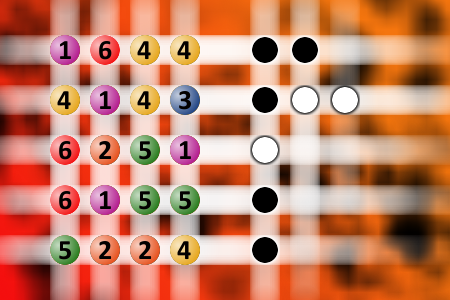
Find the right combination
[7400] Find the right combination - The computer chose a secret code (sequence of 4 digits from 1 to 6). Your goal is to find that code. Black circles indicate the number of hits on the right spot. White circles indicate the number of hits on the wrong spot. - #brainteasers #mastermind - Correct Answers: 8
BRAIN TEASERS
enter your answer and press button OK

Find the right combination

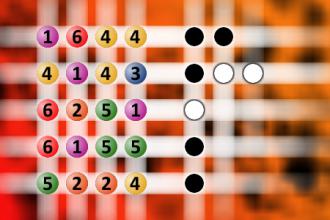
The computer chose a secret code (sequence of 4 digits from 1 to 6). Your goal is to find that code. Black circles indicate the number of hits on the right spot. White circles indicate the number of hits on the wrong spot.
Correct answers: 8
#brainteasers #mastermind
Register with your Google Account and start collecting points.
Check your ranking on list.

How long...?

When the surgeon came to see Rita on the day after her operation, she asked him somewhat hesitantly just how long it would be before she could resume her sex life.

"Uh, I hadn't really thought about it" replied the stunned surgeon.

"You're the first one ever to ask that after a nose job...."

Jokes of the day - Daily updated jokes. New jokes every day.
Follow Brain Teasers on social networks

Brain Teasers

puzzles, riddles, mathematical problems, mastermind, cinemania...

Thin-film memory

In 1960, the first electronic computer to employ thin-film memory was announced when Sperry Rand Corporation, of St. Paul, Minn., unveiled a new computer, known as Univac 1107 [left]. Thin film magnetic memory technology was developed by Sperry Rand through government funded research. A thin film (4 millionths of an inch thick) of iron-nickel alloy was deposited on small glass plates. This provided very fast access times in the range of 0.67 microseconds, but was very expensive to produce. The Univac 1107, intended for the civilian marketplace, used thin film memory only for its 128-word general register stack. Military computers, where money was less of a concern, used larger amounts of thin film memory.
This site uses cookies to store information on your computer. Some are essential to help the site properly. Others give us insight into how the site is used and help us to optimize the user experience. See our privacy policy.