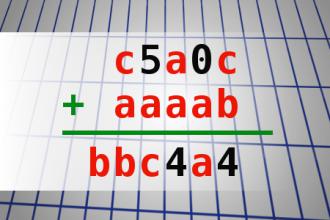
Find number abc
[7481] Find number abc - If c5a0c + aaaab = bbc4a4 find number abc. Multiple solutions may exist. - #brainteasers #math - Correct Answers: 2
BRAIN TEASERS
enter your answer and press button OK

Find number abc

If c5a0c + aaaab = bbc4a4 find number abc. Multiple solutions may exist.
Correct answers: 2
#brainteasers #math
Register with your Google Account and start collecting points.
Check your ranking on list.

Blonde Cop

A blonde, a brunette, and a redhead are walking by a mall.

A policeman starts running after them, so they start running too.

They come upon 3 sacks and jump into them.

The cop stops and kicks the 1st sack and the brunette says "Meow."

The cop says, "Oh, it's only a cat."

He kicks the 2nd sack and the redhead says "Woof."

The cop says, "Oh, it's only a dog."

Then he comes up to the third sack and kicks it.

The blonde says "Potatoes".

And the cop says "Oh, it's only a sack of potatoes!"

Do you know why the cop didn't catch her?

Because he was a blonde too!

Jokes of the day - Daily updated jokes. New jokes every day.
Follow Brain Teasers on social networks

Brain Teasers

puzzles, riddles, mathematical problems, mastermind, cinemania...

Nehemiah Grew

Died 25 Mar 1712 at age 70 (baptized 26 Sep 1641). English botanist, physician, and microscopist, who was one of the founders of the science of plant anatomy. He began observations on the anatomy of plants in 1664, and his first essay on the subject, The Anatomy of Vegetables Begun was presented to the Royal Society of London in 1670 (published 1672). He took a particular interest in determining the physiological nature of the tissues. He observed the pourous structure of plant tissue, suggested that flowers have a sexual function, and was first to use the term "comparative anatomy" (1676, in a lecture at the Royal Society). His extensive studies of plant tissues, including roots, trunks, leaves, flowers, fruits and seeds were published in a major work The Anatomy of Plants (1682). From a chemical analysis of water from springs at Epsom, Surrey, he isolated magnesium sulphate, which remains known as "Epsom Salts."
This site uses cookies to store information on your computer. Some are essential to help the site properly. Others give us insight into how the site is used and help us to optimize the user experience. See our privacy policy.