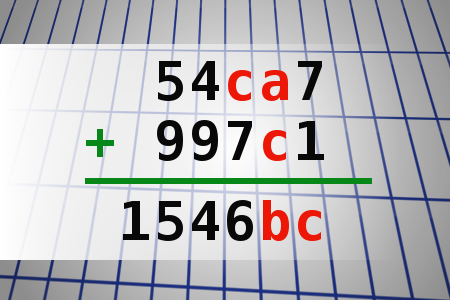
Find number abc
[7488] Find number abc - If 54ca7 + 997c1 = 1546bc find number abc. Multiple solutions may exist. - #brainteasers #math - Correct Answers: 12
BRAIN TEASERS
enter your answer and press button OK

Find number abc

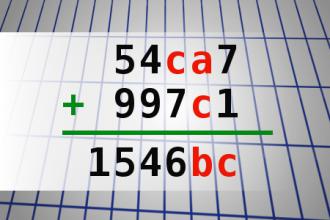
If 54ca7 + 997c1 = 1546bc find number abc. Multiple solutions may exist.
Correct answers: 12
#brainteasers #math
Register with your Google Account and start collecting points.
Check your ranking on list.

An old man walks into a bar, s...

An old man walks into a bar, sits down, and starts crying.
The bartender asks, “What’s wrong?” The old man looks at the bartender through Teary eyes and between sobs says, “I married a beautiful woman two days ago. She’s a natural blonde, twenty-five, intelligent, a marvelous cook, a meticulous housekeeper, extremely sensitive to my wants and needs, very giving, my best friend, and intensely passionate in bed.”
The bartender stares at the old man for a brief moment and says, “But that sounds great! You have what every man wants in a woman, so why are crying?”
The old man looks at the bartender and says, “I can’t remember where I live!”
Jokes of the day - Daily updated jokes. New jokes every day.
Follow Brain Teasers on social networks

Brain Teasers

puzzles, riddles, mathematical problems, mastermind, cinemania...

Karl Taylor Compton

Born 14 Sep 1887; died 22 Jun 1954 at age 66.American educator and physicist who directed development of radar during WW II. His research included the passage of photoelectrons through metals, ionization and the motion of electrons in gases, fluorescence, the theory of the electric arc, and collisions of electrons and atoms. In 1933, President Roosevelt asked him to chair the new Scientific Advisory Board. When the National Defense Research Committee was formed in 1940, he was chief of Division D (detection: radar, fire control, etc.) In 1941, he was in charge of those divisions concerned with radar within the new Office of Scientific Research and Development (OSRD). Afterwards he was cited for personally shortening the duration of the war. He was the first recipient William Procter Prize for Scientific Achievement, and brother of Arthur H. Compton.
This site uses cookies to store information on your computer. Some are essential to help the site properly. Others give us insight into how the site is used and help us to optimize the user experience. See our privacy policy.