
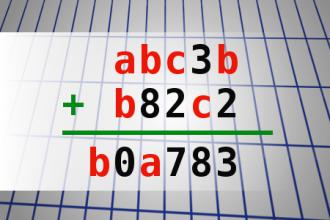
Find number abc
[7576] Find number abc - If abc3b + b82c2 = b0a783 find number abc. Multiple solutions may exist. - #brainteasers #math - Correct Answers: 1
BRAIN TEASERS
enter your answer and press button OK

Find number abc

If abc3b + b82c2 = b0a783 find number abc. Multiple solutions may exist.
Correct answers: 1
#brainteasers #math
Register with your Google Account and start collecting points.
Check your ranking on list.

Pretend Marriage

A man and a woman who had never met before, but who were both married to other people, found themselves assigned to the same sleeping room on a trans-continental train.

Though initially embarrassed and uneasy over sharing a room, they were both very tired and fell asleep quickly, he in the upper berth and she in the lower.

At 1:00 AM, the man leaned down and gently woke the woman saying “‘Ma'am, I'm sorry to bother you, but would you be willing to reach into the closet to get me a second blanket – I'm awfully cold.”

“I have a better idea,” she replied “Just for tonight,…… let's pretend that we're married.”

“Wow!…That's a great idea!”, he exclaimed.

“Good,” she replied…. “Get your own fucking blanket.”

Jokes of the day - Daily updated jokes. New jokes every day.
Follow Brain Teasers on social networks

Brain Teasers

puzzles, riddles, mathematical problems, mastermind, cinemania...

Howard T. Ricketts

Died 3 May 1910 at age 39 (born 9 Feb 1871).Howard Taylor Ricketts was an American pathologist who discovered the causative organisms and mode of transmission of Rocky Mountain spotted fever and epidemic typhus. In 1906, Ricketts, a Univeristy of Chicago pathologist, demonstrated that Rocky Mountain spotted fever is spread by cattle ticks and caused by a blood-borne "bipolar bacillus." In 1910 he showed that typhus is caused by a similar organism carried by lice. Ricketts was in Mexico City investigating the disease (known in Mexico, as tabardillo) that year when he was stricken by typhus and died at age 39. The two organisms Ricketts discovered were the first of what were later shown to be an unusual genus of virus-like bacteria - now named the Rickettsiae.
This site uses cookies to store information on your computer. Some are essential to help the site properly. Others give us insight into how the site is used and help us to optimize the user experience. See our privacy policy.