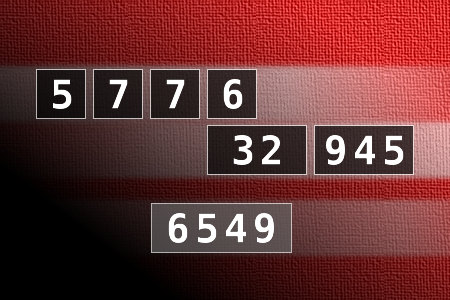
Calculate the number 6549
[7577] Calculate the number 6549 - NUMBERMANIA: Calculate the number 6549 using numbers [5, 7, 7, 6, 32, 945] and basic arithmetic operations (+, -, *, /). Each of the numbers can be used only once. - #brainteasers #math #numbermania - Correct Answers: 1
BRAIN TEASERS
enter your answer and press button OK

Calculate the number 6549

NUMBERMANIA: Calculate the number 6549 using numbers [5, 7, 7, 6, 32, 945] and basic arithmetic operations (+, -, *, /). Each of the numbers can be used only once.
Correct answers: 1
#brainteasers #math #numbermania
Register with your Google Account and start collecting points.
Check your ranking on list.

The test

Two young engineers applied for a single position at a computer company.

They both had the same qualifications. In order to determine which individual to hire, the applicants were asked to take a test by the Department manager.

Upon completion of the test, both men missed only one of the questions.

The manager went to the first applicant and said, "Thank you for your interest, but we've decided to give the job to the other applicant."

"And why would you be doing that? We both got 9 questions correct," asked the rejected applicant.

"We have based our decision not on the correct answers, but on the question you missed," said the Department manager.

"And just how would one incorrect answer be better than the other?" the rejected applicant inquired.

"Simple," said the Department manager, "Your fellow applicant put down on question #5, 'I don't know.' You put down, 'Neither do I.'"

Jokes of the day - Daily updated jokes. New jokes every day.
Follow Brain Teasers on social networks

Brain Teasers

puzzles, riddles, mathematical problems, mastermind, cinemania...

John Z. Young

Born 18 Mar 1907; died 4 Jul 1997 at age 90. John Zachary Young was an English zoologist and neuroscientist who had a passionate interest in how animals function, and their brains in particular. His research laid a foundation for modern neurobiology. His career began as a cephalopod biologist, curious also in physiology, experimental psychology and philosophy, but became a neuroscientist. His first paper (1929) was on the previously undescribed epistellar body in the octopus. He continued his research on cephalopods (octopus, squids, cuttlefish and nautiloids) with experiments on octopus learning and the basis of memory. He wrote many more papers on this subject. He identified distinct stores in the octopus brain for visual and touch memories, a brain far more complicated than previously known.«
This site uses cookies to store information on your computer. Some are essential to help the site properly. Others give us insight into how the site is used and help us to optimize the user experience. See our privacy policy.