Find number abc
[7680] Find number abc - If 762ba - 61206 = 1502c find number abc. Multiple solutions may exist. - #brainteasers #math - Correct Answers: 1
BRAIN TEASERS
enter your answer and press button OK

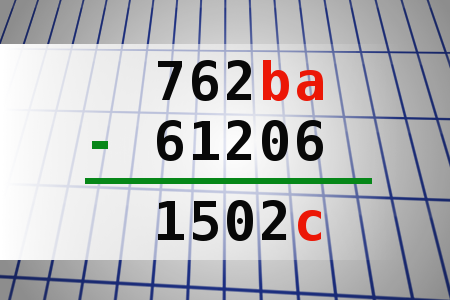
Find number abc

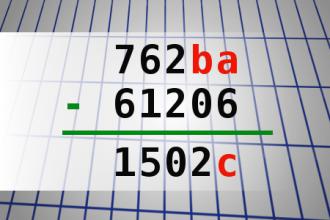
If 762ba - 61206 = 1502c find number abc. Multiple solutions may exist.
Correct answers: 1
#brainteasers #math
Register with your Google Account and start collecting points.
Check your ranking on list.

Raffle prizes...

Bubba & Earl were in the local bar enjoying a beer when the decided to get in on the weekly charity raffle. They bought five tickets each at a dollar a pop.

The following week, when the raffle was drawn, each had won a prize. Earl won 1st prize, a year's supply of gourmet spaghetti sauce and extra-long spaghetti. Bubba won 6th prize, a toilet brush.

About a week or so had passed when the men met back in the neighborhood bar for a couple of beers. Bubba asked Earl how he liked his prize, to which Earl replied, "Great, I love spaghetti! How about you, how's that toilet brush?"

"Not so good," replied Bubba, "I reckon I'm gonna go back to paper."

Jokes of the day - Daily updated jokes. New jokes every day.
Follow Brain Teasers on social networks

Brain Teasers

puzzles, riddles, mathematical problems, mastermind, cinemania...

Jean-Robert Argand

Born 18 Jul 1768; died 13 Aug 1822 at age 54.Swiss accountant and mathematician who was one of the earliest to use complex numbers, which he applied to show that all algebraic equations have roots. His name is associated with the Argand diagram, a geometrical representation of complex numbers as points in a Cartesian plane, with the real portion of the number on the x axis and the imaginary part on the y axis. He self-published this concept in an anonymous monograph (1806). Though talented in mathematics, he remained an amateur; his livelihood was asan accountant and bookkeeper. Although Argand's name became associated with this idea, the geometrical interpretation of complex numbers appeared earliest in work by Caspar Wessel (1787), first presented on 10 Mar 1797 to a the Royal Danish Academy of Sciences and published in 1799.«
This site uses cookies to store information on your computer. Some are essential to help the site properly. Others give us insight into how the site is used and help us to optimize the user experience. See our privacy policy.