
Find the right combination
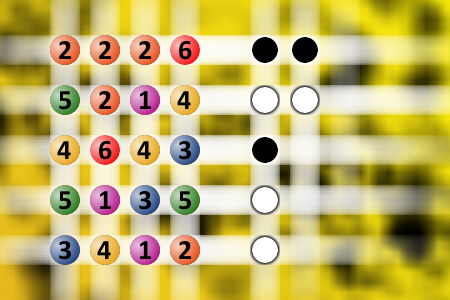
[7679] Find the right combination - The computer chose a secret code (sequence of 4 digits from 1 to 6). Your goal is to find that code. Black circles indicate the number of hits on the right spot. White circles indicate the number of hits on the wrong spot. - #brainteasers #mastermind - Correct Answers: 4
BRAIN TEASERS
enter your answer and press button OK

Find the right combination

The computer chose a secret code (sequence of 4 digits from 1 to 6). Your goal is to find that code. Black circles indicate the number of hits on the right spot. White circles indicate the number of hits on the wrong spot.
Correct answers: 4
#brainteasers #mastermind
Register with your Google Account and start collecting points.
Check your ranking on list.

Preposition

A small-town country boy gets a scholarship to Harvard. During his first week on campus, when he's still learning to get around the place, he's trying to find the library to meet up with a study group. While wandering around, he sees an older, distinguished-looking man walking by. Figuring that the man is a professor, or otherwise associated with the school, he decides to ask him for directions.

"Excuse me," he asks, "do you know where the library is at?"

The man stops, looks at him, and sniffs, "Son, at Harvard we do not end a sentence with a preposition".

"OK. Do you know where the library is at, asshole?"

Jokes of the day - Daily updated jokes. New jokes every day.
Follow Brain Teasers on social networks

Brain Teasers

puzzles, riddles, mathematical problems, mastermind, cinemania...

Francis P. Shepard

Died 25 Apr 1985 at age 87 (born 10 May 1897).Fraancis Parker Shepard was an American marine geologist who studied submarine canyons, coastal processes and features, submerged deltas, sea-level changes and continental shelves, all of which he preferred rather than deep-ocean geology. His work off the California coast near La Jolla pioneered Pacific marine geology. Although his early career began with the study of structural geology, with field trips in the Rocky Mountains leading to a Ph.D. in 1922. The next year, his father, head of Shepard Steamship Line and an avid sailor, offered the use of his yacht. Thereby, Shepard's lifetime interests shifted to marine geology. When the surface sediment samples he collected from the continental coast off the New England coast did not match what theory predicted, in 1932, he published his observations and offered new interpretations, even challenging existing ideas.«
This site uses cookies to store information on your computer. Some are essential to help the site properly. Others give us insight into how the site is used and help us to optimize the user experience. See our privacy policy.