Find number abc
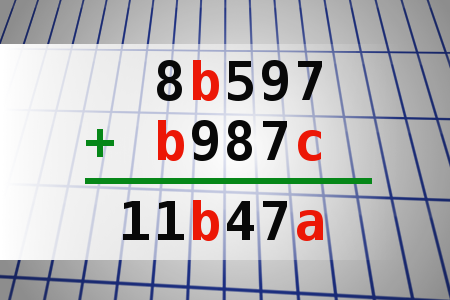
[7819] Find number abc - If 8b597 + b987c = 11b47a find number abc. Multiple solutions may exist. - #brainteasers #math - Correct Answers: 5
BRAIN TEASERS
enter your answer and press button OK

Find number abc

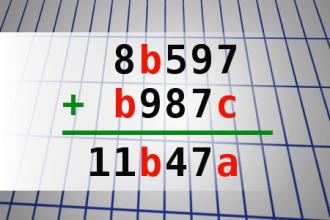
If 8b597 + b987c = 11b47a find number abc. Multiple solutions may exist.
Correct answers: 5
#brainteasers #math
Register with your Google Account and start collecting points.
Check your ranking on list.

Any little ones yet?

Mrs. O'Donovan was walking down O'Connell Street in Dublin, and coming in the opposite direction was Father O'Rafferty.

"Hello," said the Father, "And how is Mrs. O'Donovan, didn't I marry you two years ago?"

"You did that, Father."

"And are there any little ones yet?"

"No, not yet, Father." Said she.

"Well now, I'm going to Rome next week, and I'll light a candle for you."

"Thank-you, Father." And away she went.

A few years later they met again.

"Well now, Mrs. O'Donovan," said the Father, "how are you?"

"Oh, very well," said she.

"And tell me," he said, "have you any little ones yet?"

"Oh yes, Father. I've had three sets of twins, and four singles - ten in all."

"Now isn't that wonderful," he said "And how is your lovely husband?"

"Oh," she said, "he's over in Rome to blow that bloody \\candle out!"

Jokes of the day - Daily updated jokes. New jokes every day.
Follow Brain Teasers on social networks

Brain Teasers

puzzles, riddles, mathematical problems, mastermind, cinemania...

Max Schultze

Died 16 Jan 1874 at age 48 (born 25 Mar 1825).German zoologist and cytologist, known especially for his researches in microscopic anatomy. He altered the conception of the cell, emphasizing not the membrane, but the living mass of protoplasm with a nucleus (1861). He pointed out that some cells, for example those of the embryo, do not have bounding membranes. He recognized the protoplasm, with its nucleus, as the fundamental substance found in both plants and animals. Schultze also studied protozoa, and demonstrated minute nerve endings in the ear (1858), nose (1863), and retina (1866). He was an outstanding histologist, introducing several new techniques in histology, including the use of osmic acid for staining fine details of cells. His sudden death in 1874 was caused by a perforated ulcer.
This site uses cookies to store information on your computer. Some are essential to help the site properly. Others give us insight into how the site is used and help us to optimize the user experience. See our privacy policy.