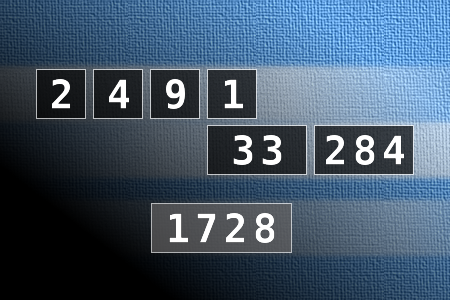
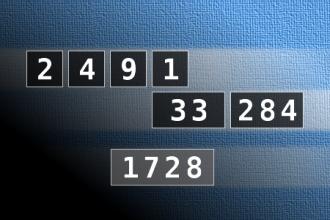
Calculate the number 1728
[7820] Calculate the number 1728 - NUMBERMANIA: Calculate the number 1728 using numbers [2, 4, 9, 1, 33, 284] and basic arithmetic operations (+, -, *, /). Each of the numbers can be used only once. - #brainteasers #math #numbermania - Correct Answers: 2
BRAIN TEASERS
enter your answer and press button OK

Calculate the number 1728

NUMBERMANIA: Calculate the number 1728 using numbers [2, 4, 9, 1, 33, 284] and basic arithmetic operations (+, -, *, /). Each of the numbers can be used only once.
Correct answers: 2
#brainteasers #math #numbermania

Register with your Google Account and start collecting points.
Check your ranking on list.

A Good Day for Ice Fishing

After church, little Johnny and his brother go ice fishing. Little Johnny starts drilling on the ice when a voice from above says, "Young man, there's no fish down there.”Little Johnny asks his brother, "Who is that?"His brother replies, "I don't know."So little Johnny starts to drill again and the voice says again, "For the second time, there's no fish down there."Little Johnny asks his brother, "Could that be God?"His brother replies again, "I don't know." Little Johnny starts drilling again and the voice says once more, "Young man, for the last time, I'm telling you there's no fish down there."Johnny looks up and asks, "Is that you, God?"The voice says, "No, I'm the manager and the rink's closed."-
Jokes of the day - Daily updated jokes. New jokes every day.
Follow Brain Teasers on social networks

Brain Teasers

puzzles, riddles, mathematical problems, mastermind, cinemania...

Sir J.J. Thomson

Born 18 Dec 1856; died 30 Aug 1940 at age 83. Joseph John Thomson was an English physicist who helped revolutionize the knowledge of atomic structure by his discovery of the electron (1897). He received the Nobel Prize for Physics in 1906 and was knighted in 1908. Thomson experimented with currents of electricity inside empty glass tubes, investigating a long-standing puzzle known as “cathode rays.” His experiments prompted him to make a bold proposal: these mysterious rays are streams of particles much smaller than atoms. He called these particles “corpuscles,” and suggested that they might make up all of the matter in atoms. It was startling to imagine particles inside the atom at a time when most people thought that the atom was indivisible, the most fundamental unit of matter.
This site uses cookies to store information on your computer. Some are essential to help the site properly. Others give us insight into how the site is used and help us to optimize the user experience. See our privacy policy.