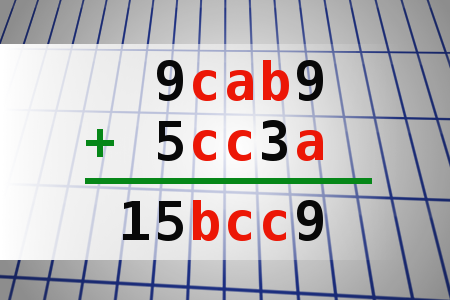
Find number abc
[7825] Find number abc - If 9cab9 + 5cc3a = 15bcc9 find number abc. Multiple solutions may exist. - #brainteasers #math - Correct Answers: 1
BRAIN TEASERS
enter your answer and press button OK

Find number abc

If 9cab9 + 5cc3a = 15bcc9 find number abc. Multiple solutions may exist.
Correct answers: 1
#brainteasers #math
Register with your Google Account and start collecting points.
Check your ranking on list.

Tea set

A girl was given a tea set for her second birthday. It became one of her favorite toys, and when her mother went away for a few weeks to care for her sick aunt, the toddler loved to take her father a little cup of tea, which was just water really, while he was engrossed watching the news on TV. He sipped each "cup of tea" he was brought and lavished generous praise on the taste, leaving the little girl immensely proud.

Eventually the mother returned home and the father couldn't wait to show her how his little princess had been looking after him. On cue, the girl took him his "cup of tea" and he sipped it before praising it to the heavens.

The mother watched him drink it and said: "Did it ever occur to you that the only place she can reach to get water is the toilet?"

Jokes of the day - Daily updated jokes. New jokes every day.
Follow Brain Teasers on social networks

Brain Teasers

puzzles, riddles, mathematical problems, mastermind, cinemania...

James B. Sumner

Died 12 Aug 1955 at age 67 (born 19 Nov 1887).James Batcheller Sumner was an American biochemist who shared (with John Howard Northrop and Wendell Meredith Stanley) the 1946 Nobel Prize for Chemistry. Sumner was the first to crystallize an enzyme to show that enzymes were proteins. He learned to live one-handed from age 17, due to an accident. After earning his Ph.D. (1914), he joined the faculty of Cornell University Medical College. By 1917, he began investigating the protein nature of enzymes. It was technically difficult, taking nine years, before he produced a crystalline globulin with high urease activity in 1926. The significance of his work went unappreciated for a number of years, but by 1946, he was awarded a half-share of the Nobel Prize for Chemistry, “for his discovery that enzymes can be crystallized.” In 1947 he became director of a new laboratory for enzyme chemistry, at Cornell.«
This site uses cookies to store information on your computer. Some are essential to help the site properly. Others give us insight into how the site is used and help us to optimize the user experience. See our privacy policy.