Find number abc
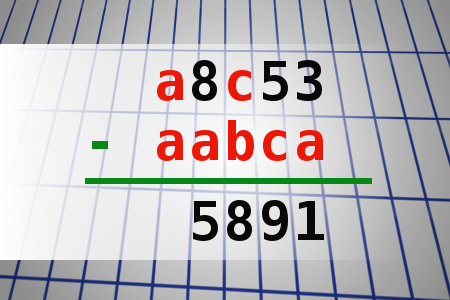
[7835] Find number abc - If a8c53 - aabca = 5891 find number abc. Multiple solutions may exist. - #brainteasers #math - Correct Answers: 1
BRAIN TEASERS
enter your answer and press button OK

Find number abc

If a8c53 - aabca = 5891 find number abc. Multiple solutions may exist.
Correct answers: 1
#brainteasers #math
Register with your Google Account and start collecting points.
Check your ranking on list.

From the Blonde Files – Horseback Riding

A blonde decides to try horseback riding, even though she has had no lessons or prior experience. She mounts the horse unassisted, and the horse immediately springs into motion.
It gallops along at a steady and rhythmic pace, but the blond begins to slide from the saddle. In terror, she grabs for the horse's mane, but cannot seem to get a firm grip. She tries to throw her arms around the horse's neck, but she slides down the horse's side anyway.
The horse gallops along, seemingly oblivious of its slipping rider.
Finally, giving up her frail grip, the blond attempts to leap away from the horse and throw herself to safety. Unfortunately, her foot has become entangled in the stirrup, she is now at the mercy of the horse's pounding hooves as her head is struck against the ground over and over.
As her head is battered against the ground, she is mere moments away from unconsciousness when to her great fortune Frank, a Wal-Mart greeter, sees her dilemma and unplugs the horse.
...... And you thought all they did was say Hello.

Jokes of the day - Daily updated jokes. New jokes every day.
Follow Brain Teasers on social networks

Brain Teasers

puzzles, riddles, mathematical problems, mastermind, cinemania...

Brook Taylor

Died 29 Dec 1731 at age 46 (born 18 Aug 1685).British mathematician, best known for the Taylor's series, a method for expanding functions into infinite series. In 1708, Taylor produced a solution to the problem of the centre of oscillation. His Methodus incrementorum directa et inversa (“Direct and Indirect Methods of Incrementation,” 1715) introduced what is now called the calculus of finite differences. Using this, he was the first to express mathematically the movement of a vibrating string on the basis of mechanical principles. Methodus also contained Taylor's theorem, later recognized (1772) by Joseph Lagrange as the basis of differential calculus. A gifted artist, Taylor also wrote on basic principles of perspective (1715) containing the first general treatment of the principle of vanishing points.«
This site uses cookies to store information on your computer. Some are essential to help the site properly. Others give us insight into how the site is used and help us to optimize the user experience. See our privacy policy.