Find the right combination
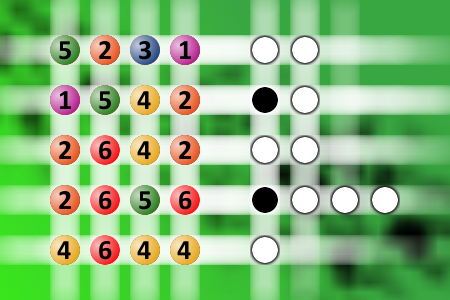
[7834] Find the right combination - The computer chose a secret code (sequence of 4 digits from 1 to 6). Your goal is to find that code. Black circles indicate the number of hits on the right spot. White circles indicate the number of hits on the wrong spot. - #brainteasers #mastermind - Correct Answers: 2
BRAIN TEASERS
enter your answer and press button OK

Find the right combination

The computer chose a secret code (sequence of 4 digits from 1 to 6). Your goal is to find that code. Black circles indicate the number of hits on the right spot. White circles indicate the number of hits on the wrong spot.
Correct answers: 2
#brainteasers #mastermind
Register with your Google Account and start collecting points.
Check your ranking on list.

One day, a guy went into a sto...

One day, a guy went into a store, just browsing.

He suddenly saw a statue of a rat made of bronze, and thought that it was interesting. He decided to buy it, and so he did.

The guy walked out of the store, carrying the statue in his arms. Suddenly some rats started following him.

He shrugged it off, and continued on his way.

As he walked along, more and more rats started following him, until all the rats in the city were behind him.

He suddenly realized that it was the statue that was doing this.

He headed towards the bay that resided next to the city, and threw the statue in. The rats followed, not caring about their immediate deaths.

The guy ran back to the store, and when he reached it, the store owner said, "No refunds".

The guy shook his head, and said, "No, no, I was wondering if you had any statues like the one I bought, only, shaped like a lawyer."
Jokes of the day - Daily updated jokes. New jokes every day.
Follow Brain Teasers on social networks

Brain Teasers

puzzles, riddles, mathematical problems, mastermind, cinemania...

Philip W. Anderson

Born 13 Dec 1923. Philip Warren Anderson is an American physicist who shared (with John H. Van Vleck and Sir Nevill F. Mott)the 1977 Nobel Prize for Physics for his research on semiconductors, superconductivity, and magnetism. He made contributions to the study of solid-state physics, and research on molecular interactions has been facilitated by his work on the spectroscopy of gases. He conceived a model (known as the Anderson model) to describe what happens when an impurity atom is present in a metal. He also investigated magnetism and superconductivity, and his work is of fundamental importance for modern solid-state electronics, making possible the development of inexpensive electronic switching and memory devices in computers.
This site uses cookies to store information on your computer. Some are essential to help the site properly. Others give us insight into how the site is used and help us to optimize the user experience. See our privacy policy.