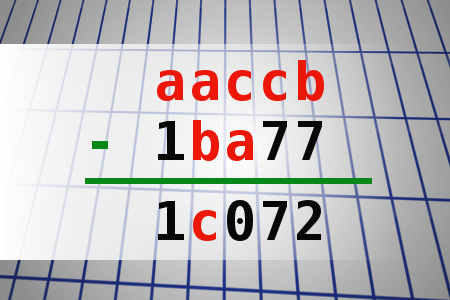
Find number abc
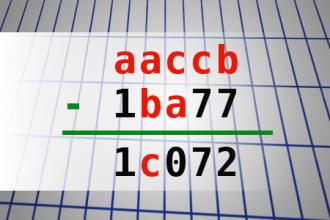
If aaccb - 1ba77 = 1c072 find number abc. Multiple solutions may exist.Correct answers: 1
#brainteasers #math

Competition Of A Nation
The Americans and Russians at the height of the arms race realized that if they continued in the usual manner they were going to blow up the whole world.
One day they sat down and decided to settle the whole dispute with one dog fight. They'd have five years to breed the best fighting dog in the world and whichever side's dog won would be entitled to dominate the world. The losing side would have to lay down its arms. The Russians found the biggest meanest Doberman and Rottweiler dogs in the world and bred them with the biggest meanest Siberian wolves. They selected only the biggest and strongest puppy from each litter, killed his siblings, and gave him all the milk. The used steroids and trainers and after five years came up with the biggest meanest dog the world had ever seen. Its cage needed steel bars that were five inches thick and nobody could get near it.
"When the day came for the fight, the Americans showed up with a strange animal. It was a nine foot long Dachshund. Everyone felt sorry for the Americans because they knew there was no way that this dog could possibly last ten seconds with the Russian dog.
"When the cages were opened up, the Dachshund came out and wrapped itself around the outside of the ring. It had the Russian dog almost completely surrounded. When the Russian dog leaned over to bite the Dachshund's neck, the Dachshund leaned up and consumed the Russian dog in one bite. There was nothing left at all of the Russian dog.
The Russians came up to the Americans shaking their heads in disbelief. `We don't understand how this could have happened. We had our best people working for five years with the meanest Doberman and Rottweiler dogs in the world and the biggest meanest Siberian wolves."
"That's nothing", an American replied. "We had our best plastic surgeons working for five years trying to make an alligator look like a Dachshund.'"
One day they sat down and decided to settle the whole dispute with one dog fight. They'd have five years to breed the best fighting dog in the world and whichever side's dog won would be entitled to dominate the world. The losing side would have to lay down its arms. The Russians found the biggest meanest Doberman and Rottweiler dogs in the world and bred them with the biggest meanest Siberian wolves. They selected only the biggest and strongest puppy from each litter, killed his siblings, and gave him all the milk. The used steroids and trainers and after five years came up with the biggest meanest dog the world had ever seen. Its cage needed steel bars that were five inches thick and nobody could get near it.
"When the day came for the fight, the Americans showed up with a strange animal. It was a nine foot long Dachshund. Everyone felt sorry for the Americans because they knew there was no way that this dog could possibly last ten seconds with the Russian dog.
"When the cages were opened up, the Dachshund came out and wrapped itself around the outside of the ring. It had the Russian dog almost completely surrounded. When the Russian dog leaned over to bite the Dachshund's neck, the Dachshund leaned up and consumed the Russian dog in one bite. There was nothing left at all of the Russian dog.
The Russians came up to the Americans shaking their heads in disbelief. `We don't understand how this could have happened. We had our best people working for five years with the meanest Doberman and Rottweiler dogs in the world and the biggest meanest Siberian wolves."
"That's nothing", an American replied. "We had our best plastic surgeons working for five years trying to make an alligator look like a Dachshund.'"