MAGIC SQUARE: Calculate A-B-C
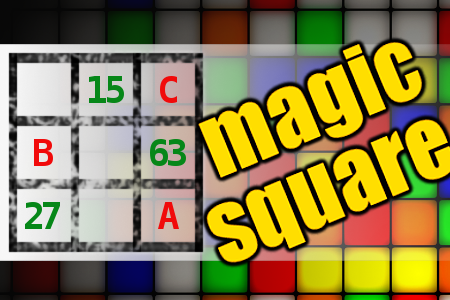
[8108] MAGIC SQUARE: Calculate A-B-C - The aim is to place the some numbers from the list (15, 16, 24, 27, 28, 36, 37, 63, 64, 72) into the empty squares and squares marked with A, B an C. Sum of each row and column should be equal. All the numbers of the magic square must be different. Find values for A, B, and C. Solution is A-B-C. - #brainteasers #math #magicsquare - Correct Answers: 0
BRAIN TEASERS
enter your answer and press button OK

MAGIC SQUARE: Calculate A-B-C

The aim is to place the some numbers from the list (15, 16, 24, 27, 28, 36, 37, 63, 64, 72) into the empty squares and squares marked with A, B an C. Sum of each row and column should be equal. All the numbers of the magic square must be different. Find values for A, B, and C. Solution is A-B-C.
Correct answers: 0
#brainteasers #math #magicsquare
Register with your Google Account and start collecting points.
Check your ranking on list.

Funny Christmas cracker jokes

What do they sing at a snowman's birthday party?
Freeze a jolly good fellow

Why does Santa have three gardens?
So he can 'ho ho ho'!

What does Miley Cyrus have at Christmas?
Twerky!

Why did Santa's helper see the doctor?

Because he had a low "elf" esteem!

Who is Santa's favorite singer?
Elf-is Presley!

What do Santa's little helpers learn at school?

The elf-abet!

Why are Christmas trees so bad at sewing?

They always drop their needles!

Did Rudolph go to school?
No. He was Elf-taught!

How do snowmen get around?

They ride an icicle!

Jokes of the day - Daily updated jokes. New jokes every day.
Follow Brain Teasers on social networks

Brain Teasers

puzzles, riddles, mathematical problems, mastermind, cinemania...

James Challis

Died 3 Dec 1882 at age 78 (born 12 Dec 1803).English astronomer and clergyman, famous in the history of astronomy for his failure to discover the planet Neptune. Astronomer and mathematician John Couch Adams had studied the known deviations in the orbit of the planet Uranus which indicated a planet even further out. In 1845, Adams gave Astronomer Royal George Airy a calculated orbital path for the unknown planet. But Airy was more interested in the primary job of navigation and timekeeping observations. Airy informed Challis, who did not begin until July 1846, and actually sighted the new planet four times without recognising it. On 23 Sep 1845, the new planet was instead discovered from Berlin Observatory. Challis admitted that Adam's prediction was within 2° of the planet's position.
This site uses cookies to store information on your computer. Some are essential to help the site properly. Others give us insight into how the site is used and help us to optimize the user experience. See our privacy policy.