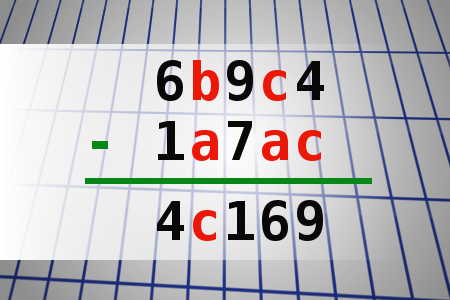
Find number abc
[8191] Find number abc - If 6b9c4 - 1a7ac = 4c169 find number abc. Multiple solutions may exist. - #brainteasers #math - Correct Answers: 0
BRAIN TEASERS
enter your answer and press button OK

Find number abc

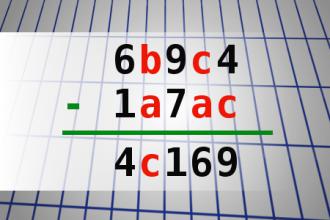
If 6b9c4 - 1a7ac = 4c169 find number abc. Multiple solutions may exist.
Correct answers: 0
#brainteasers #math
Register with your Google Account and start collecting points.
Check your ranking on list.

It doesn't hurt to take a har...

It doesn't hurt to take a hard look at yourself from time to time, and this should help get you started.
During a visit to the mental asylum, a visitor asked the director what the criterion was that defined whether or not a patient should be institutionalized.
"Well," said the Director, "we fill up a bathtub, then we offer a teaspoon, a teacup and a bucket to the patient and ask him or her to empty the bathtub."
"Oh, I understand," said the visitor. "A normal person would use the bucket because it's bigger than the spoon or the teacup."
"No," said the Director, "A normal person would pull the plug. Do you want a room with or without a view?"
Jokes of the day - Daily updated jokes. New jokes every day.
Follow Brain Teasers on social networks

Brain Teasers

puzzles, riddles, mathematical problems, mastermind, cinemania...

Oliver Perry Hay

Born 22 May 1846; died 2 Nov 1930 at age 84.American paleontologist whose catalogs of fossil vertebrates greatly organized existing knowledge and became standard references. From 1912, he conduct his research at the United States National Museum where he assisted in working up and describing the museum's collections in vertebrate paleontology. Hay's primary scientific interest was the study of the Pleistocene vertebrata of North America. He is renowned for his work on skull and brain anatomy. His first major work was his Bibliography and Catalogue of the Fossil Vertebrata of North America (1902), supplemented by two more volumes (1929-30). Hay also wrote on the evidence of early humans in North America.«[Image: Diplodocus is portrayed as a slithering sauropod by Oliver P. Hay, 1910. From Oliver P. Hay, Proceedings of the Washington Academy of Sciences, vol. 12, 1910, pp. 1-25]
This site uses cookies to store information on your computer. Some are essential to help the site properly. Others give us insight into how the site is used and help us to optimize the user experience. See our privacy policy.