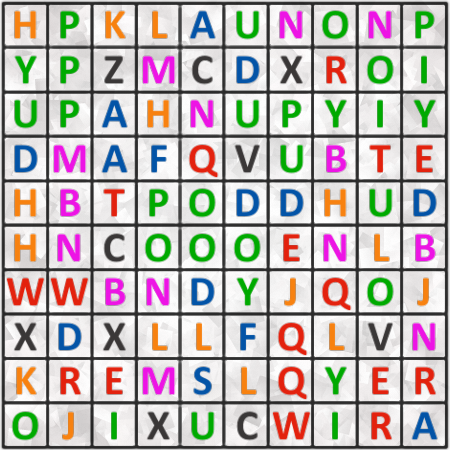
Find the 10 letters word
[1925] Find the 10 letters word - Find the 10 letters word. Word may go in all 8 directions. - #brainteasers #wordpuzzles - Correct Answers: 53 - The first user who solved this task is Djordje Timotijevic
BRAIN TEASERS
enter your answer and press button OK

Find the 10 letters word

Find the 10 letters word. Word may go in all 8 directions.
Correct answers: 53
The first user who solved this task is Djordje Timotijevic.
#brainteasers #wordpuzzles
Register with your Google Account and start collecting points.
Check your ranking on list.

Hospital Trolley

A beautiful young girl is about to undergo a minor operation. She's laid on a hospital trolley bed with nothing on, except a sheet over her. The nurse pushes the trolley down the corridor towards the operating theatre, where she leaves the girl on the trolley outside, while she goes in to check whether everything is ready. A young man wearing a white coat approaches, lifts the sheet up and starts examining her naked body. He puts the sheet back and then walks away and talks to another man in a white coat. The second man comes over, lifts the sheet and does the same examinations. When a third man does the same thing, but more closely, she grows impatient and says: "All these examinations are fine and appreciated, but when are you going to start the operation?"
The man in the white coat shrugged his shoulders: "I have no idea. We're just painting the corridor."    

Jokes of the day - Daily updated jokes. New jokes every day.
Follow Brain Teasers on social networks

Brain Teasers

puzzles, riddles, mathematical problems, mastermind, cinemania...

Max Planck

Born 23 Apr 1858; died 4 Oct 1947 at age 89. Max Karl Ernst Ludwig Planck was a German theoretical physicist who studied at Munich and Berlin, where he studied under Helmholtz, Clausius and Kirchhoff and subsequently joined the faculty. He became professor of theoretical physics (1889-1926). His work on the law of thermodynamics and the distribution of radiation from a black body led him to abandon classical Newtonian principles and introduce the quantum theory (1900), for which he was awarded the Nobel Prize for Physics in 1918. This assumes that energy is not infinitely subdivisible, but ultimately exists as discrete amounts he called quanta (Latin, “how much”). Further, the energy carried by a quantum depends in direct proportion to the frequency of its source radiation.
This site uses cookies to store information on your computer. Some are essential to help the site properly. Others give us insight into how the site is used and help us to optimize the user experience. See our privacy policy.