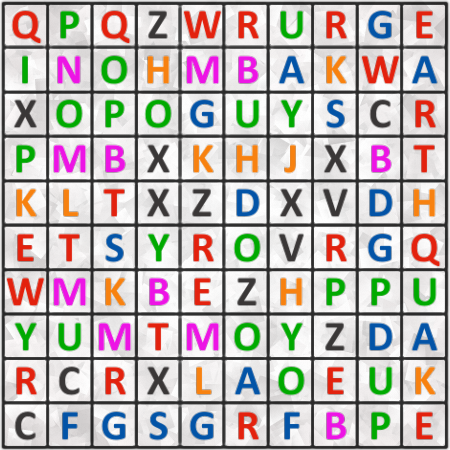
Find the 10 letters word
[2914] Find the 10 letters word - Find the 10 letters word. Word may go in all 8 directions. - #brainteasers #wordpuzzles - Correct Answers: 54 - The first user who solved this task is On On Lunarbasil
BRAIN TEASERS
enter your answer and press button OK

Find the 10 letters word

Find the 10 letters word. Word may go in all 8 directions.
Correct answers: 54
The first user who solved this task is On On Lunarbasil.
#brainteasers #wordpuzzles
Register with your Google Account and start collecting points.
Check your ranking on list.

An explorer walked into a clea...

An explorer walked into a clearing and was surprised to see a pigmy standing beside a huge dead elephant. "Did you kill that?" he asked. The pigmy answered: "Yes". "How could a little bloke like you kill something as huge as that?"
"I killed it with my club" replied the pigmy.
"That's amazing," said the explorer. "How big's your club?"
The pigmy replied: "There's about 150 of us"
Jokes of the day - Daily updated jokes. New jokes every day.
Follow Brain Teasers on social networks

Brain Teasers

puzzles, riddles, mathematical problems, mastermind, cinemania...

ARPANET linked four nodes

In 1969, the nacent ARPANET grew to four nodes when ARPA (the U.S. Department of Defense's Advanced Research Projects Agency) connected computer network nodes at four universities: the University of California, Los Angeles (UCLA), the Stanford Research Institute (SRI) in Menlo Park, Calif., U.C. Santa Barbara, and the University of Utah. Initial test login characters had been sent on 29 Oct 1969 from a ULCA computer to a computer at SRI, which were permanently connected on 21 Nov 1969 through early routers (small packet-switching computers then called Interface Message Processors). This “network of networks” eventually evolved into what became known as the Internet of the mid-1980s.«Image: Diagram of ARPA Network, Dec 1969, 4 nodes. From bottom, clockwise, links with computers at UCLA, UCSB, SRI and Utah.
This site uses cookies to store information on your computer. Some are essential to help the site properly. Others give us insight into how the site is used and help us to optimize the user experience. See our privacy policy.