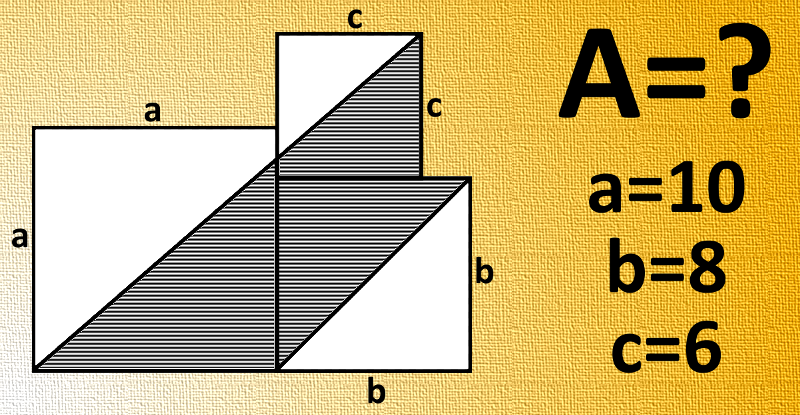
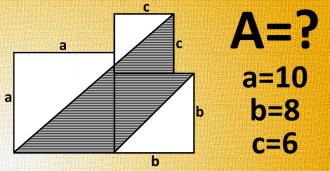
Find the area of the shaded ...
[2485] Find the area of the shaded ... - Find the area of the shaded region accurate up to 3 decimal places. (a=10, b=8, c=6) - #brainteasers #math - Correct Answers: 122 - The first user who solved this task is Roxana zavari
BRAIN TEASERS
enter your answer and press button OK

Find the area of the shaded ...

Find the area of the shaded region accurate up to 3 decimal places. (a=10, b=8, c=6)
Correct answers: 122
The first user who solved this task is Roxana zavari.
#brainteasers #math
Register with your Google Account and start collecting points.
Check your ranking on list.

The Fourth of July was coming...

The Fourth of July was coming up, and the nursery school teacher took the opportunity to tell her class about patriotism. "We live in a great country," she said. "One of the things we should be happy about is that, in this country, we are all free."
One little boy came walking up to her from the back of the room. He stood with his hands on his hips and said, "I'm not free. I'm four."
Jokes of the day - Daily updated jokes. New jokes every day.
Follow Brain Teasers on social networks

Brain Teasers

puzzles, riddles, mathematical problems, mastermind, cinemania...

Elso Sterrenberg Barghoorn

Born 30 Jun 1915; died 22 Jan 1984 at age 68.American paleontologist whose continuing investigations of plant fossils successively pushed back the estimates of the origin of life to more than 3.4 thousand million years ago. In the 1950s, near Lake Superior, Barghoorn discovered fossilized colonies of blue-green algae and aquatic fungi dating to two thousand million years old. By the 1960s, he had found fossil evidence dating back another thousand million years, suggesting life appearing shortly after Earth's origin provided suitable environment conditions. The oldest fossil remains of life were organisms closely resembling today's blue-green algae (bacteria using chlorophyll for photosynthesis), found in rock from South Africa. He also contributed to understanding the early evolution of flowering plants, vegetational changes during the Pleistocene ice age, and the formation of coal.«
This site uses cookies to store information on your computer. Some are essential to help the site properly. Others give us insight into how the site is used and help us to optimize the user experience. See our privacy policy.