
Remove 5 letters from this s...
[2486] Remove 5 letters from this s... - Remove 5 letters from this sequence (HCARDEIOGARARMT) to reveal a familiar English word. - #brainteasers #wordpuzzles - Correct Answers: 99 - The first user who solved this task is Roxana zavari
BRAIN TEASERS
enter your answer and press button OK

Remove 5 letters from this s...

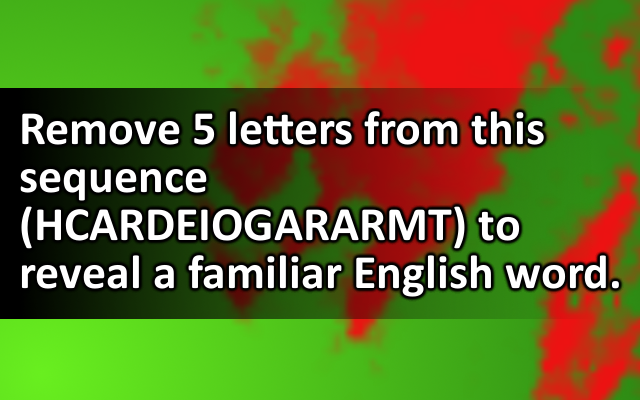
Remove 5 letters from this sequence (HCARDEIOGARARMT) to reveal a familiar English word.
Correct answers: 99
The first user who solved this task is Roxana zavari.
#brainteasers #wordpuzzles

Register with your Google Account and start collecting points.
Check your ranking on list.

A man who was having heart tro...

A man who was having heart trouble went to the doctor to see what his options were. Naturally, the doctor recommended a heart transplant. The man reluctantly agreed, and asked if there were any hearts immediately available, considering that money was no object.
"I do have three hearts," said the doctor. "The first is from an 18-year old kid, non-smoker, athletic, swimmer, with a great diet. He hit his head on the swimming pool and died. It's $100,000. The second is from a marathon runner, 25 years old, great condition, very strong. He got hit by a bus. It's $150,000. The third is from a heavy drinker, cigar smoker, steak lover. It's $500,000."
"Hey, why is that heart so expensive? He lived a terrible life!"
"Yes, but it's from a lawyer. It's never been used."
Jokes of the day - Daily updated jokes. New jokes every day.
Follow Brain Teasers on social networks

Brain Teasers

puzzles, riddles, mathematical problems, mastermind, cinemania...

Kenneth Wartinbee Spence

Died 12 Jan 1967 at age 59 (born 6 May 1907).U.S. psychologist who attempted to construct a comprehensive theory of behaviour to encompass conditioning and other simple forms of learning and behaviour modification. He is known for both theoretical and experimental research on learning. Spence was particularly interested in learning and conditioning. He extended the research and theories of Hull, in an attempt to establish a precise, mathematical formulation to describe the acquisition of learned behavior. He tried to measure simple learned behaviors such as salivating in anticipation of eating. Much of his research focused on classically conditioned, easily measured, eye-blinking behavior in relation to anxiety and other factors.
This site uses cookies to store information on your computer. Some are essential to help the site properly. Others give us insight into how the site is used and help us to optimize the user experience. See our privacy policy.