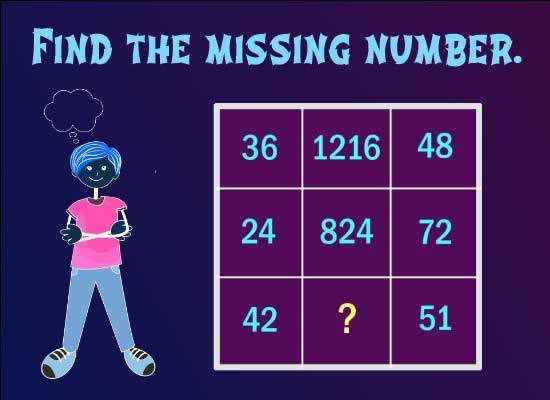
Find the missing number
[2284] Find the missing number - Try to solve this mathematical puzzle. Find the missing number. - #brainteasers #math - Correct Answers: 71 - The first user who solved this task is Roxana zavari
BRAIN TEASERS
enter your answer and press button OK

Find the missing number

Try to solve this mathematical puzzle. Find the missing number.
Correct answers: 71
The first user who solved this task is Roxana zavari.
#brainteasers #math
Register with your Google Account and start collecting points.
Check your ranking on list.

New 2023 Thanksgiving jokes

What kind of dessert sticks to the wall?
Pie-der Man!

What do you call roasted vegetables that run from the kitchen to the table?
Hustle Sprouts!

Need more Thanksgiving jokes? We have huge Thanksgiving jokes collection

If the Mayflower brought the Pilgrims, what brought their dogs?
The Collie-flower!

What do you call the ghost of a turkey?
A poultry-geist!

Why are turkeys always grumbling?
They’re in a fowl mood!

Has this meat juice been listening to Joe Rogan?
It’s so baste!

How did the turkey get to Thanksgiving?
He rode the gravy train!

Why did the turkey’s dad make him eat nothing but stale bread?
To stuffin’ him up!

Why did the turkey cross the road?
He was trying to convince people he was a chicken!

These used to be plain old cranberries. Now, they’re a flying sauce-er!
(throw cranberry sauce across the room)

Jokes of the day - Daily updated jokes. New jokes every day.
Follow Brain Teasers on social networks

Brain Teasers

puzzles, riddles, mathematical problems, mastermind, cinemania...

George Ledyard Stebbins

Born 6 Jan 1906; died 19 Jan 2000 at age 94.American geneticist who was one of the leading evolutionary biologists. Stebbins is considered one of the "architects" of the modern evolutionary synthesis of the 1930-40s (with Dobzhansky, animal systematist Ernst Mayr, and paleontologist George Gaylord Simpson ) Together, their work was a synthesis of research in cytology, genetics, systematics, paleontology. Stebbins created a modern framework for the study of plant evolution. From the 1940s, he artificially created fertile hybrids having more than twice the basic number of chromosomes (and was the first scientist to do so). This technique had value in both taxonomy and plant breeding.
This site uses cookies to store information on your computer. Some are essential to help the site properly. Others give us insight into how the site is used and help us to optimize the user experience. See our privacy policy.