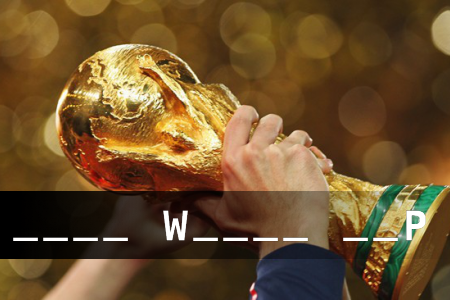

Find the missing text [**** W**** **P]
[1700] Find the missing text [**** W**** **P] - Background picture associated with the solution. - #brainteasers #wordpuzzles - Correct Answers: 104 - The first user who solved this task is James Lillard
BRAIN TEASERS
enter your answer and press button OK

Find the missing text [**** W**** **P]

Background picture associated with the solution.
Correct answers: 104
The first user who solved this task is James Lillard.
#brainteasers #wordpuzzles

Register with your Google Account and start collecting points.
Check your ranking on list.

This one never gets old - The New CEO

A company, feeling it was time for a shakeup, hired a new CEO.
The new boss was determined to rid the company of all slackers.
On a tour of the facilities, the CEO noticed a guy leaning against a wall and idly picking his teeth.
The room was full of workers and he wanted to let them know that he meant business.
He asked the guy, “How much money do you make a week?”
A little surprised, the young man looked at him and said, “I make $400 a week. Why?”
The CEO said,”Wait right here.”
He walked back to his office, came back in two minutes, and handed the guy $1,600 in cash and said, “Here’s four weeks’ pay.
Now GET OUT and don’t come back.”
Feeling pretty good about himself the CEO looked around the room and asked,
“Does anyone want to tell me what that goof-ball did here?”
From across the room a voice said,
“Sure – he was the Pizza delivery guy from Domino’s and was just waiting to collect the money!”

Jokes of the day - Daily updated jokes. New jokes every day.
Follow Brain Teasers on social networks

Brain Teasers

puzzles, riddles, mathematical problems, mastermind, cinemania...

Carl R. Rogers

Born 8 Jan 1902; died 4 Feb 1987 at age 85. American psychologist who founded humanistic psychology. The non-directive or client-centered, approach to psychotherapy that he originated stresses the importance of a personal relationship between therapist and client. He further pioneered encounter group technique. In Client-Centered Therapy (1951), he suggested that by neutrally reflecting clients' feelings, the therapist can create an empathetic environment, in which patients regulate the direction, speed of their own growth and duration of treatment. His methods greatly influenced the course of psychotherapy.
This site uses cookies to store information on your computer. Some are essential to help the site properly. Others give us insight into how the site is used and help us to optimize the user experience. See our privacy policy.