Find the next number in the ...
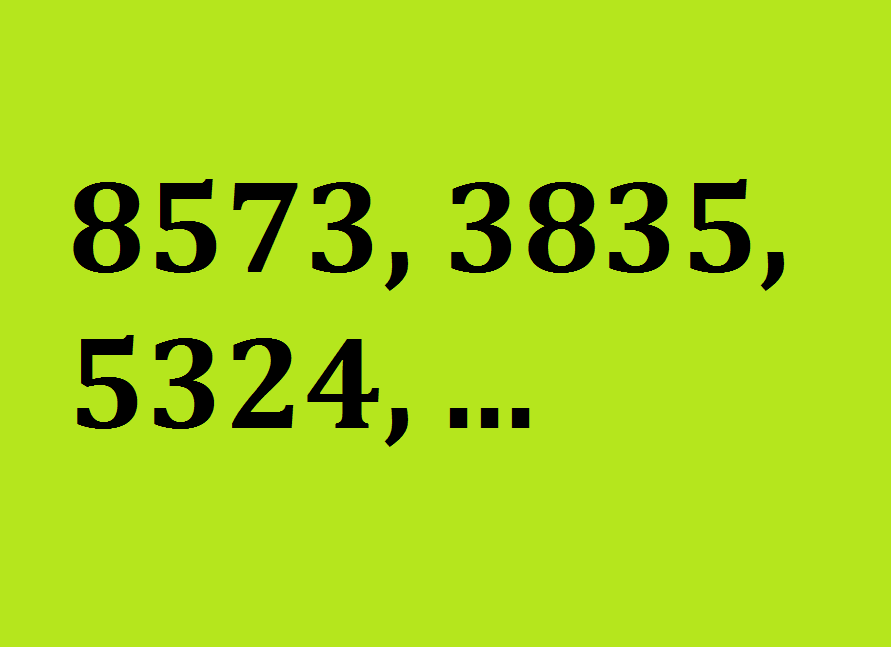
[5283] Find the next number in the ... - Find the next number in the sequence 8573, 3835, 5324, ... - #brainteasers #math - Correct Answers: 40 - The first user who solved this task is Alfa Omega
BRAIN TEASERS
enter your answer and press button OK

Find the next number in the ...

Find the next number in the sequence 8573, 3835, 5324, ...
Correct answers: 40
The first user who solved this task is Alfa Omega.
#brainteasers #math
Register with your Google Account and start collecting points.
Check your ranking on list.

Special golf ball

Two friends went out to play golf and were about to tee off, when one fellow noticed that his partner had just one golf ball.

“Don’t you have at least one other golf ball?” he asked.

The other guy replied that no, he only needed the one.

“Are you sure?” the friend persisted. “What happens if you lose that ball?”

The other guy replied, “This is a very special golf ball. I won’t lose it so I don’t need another one.”

"Well,” the friend asked, “what happens if you miss your shot and the ball goes in the lake?”

“That’s OK,” he replied, “this special golf ball floats. I’ll be able to retrieve it.”

“Well what happens if you hit it into the trees and it gets lost among the bushes and shrubs?”

The other guy replied, “That’s OK too. You see, this special golf ball has a homing beacon. I’ll be able to get it back -- no problem.”

Exasperated, the friend asks, “OK. Let’s say our game goes late, the sun goes down, and you hit your ball into a sand trap. What are you going to do then?”

“No problem,” says the other guy, “you see, this ball is florescent. I’ll be able to see it in the dark.”

Finally satisfied that he needs only the one golf ball, the friend asks, “Hey, where did you get a golf ball like that anyway?”

The other guy replies, “I found it.”

Jokes of the day - Daily updated jokes. New jokes every day.
Follow Brain Teasers on social networks

Brain Teasers

puzzles, riddles, mathematical problems, mastermind, cinemania...

Alfred Werner

Born 12 Dec 1866; died 15 Nov 1919 at age 52.Swiss chemist whose founding research into the structure of coordination compounds brought him the 1913 Nobel Prize for Chemistry. He demonstrated that stereochemistry was not just the property of carbon compounds, but was general to the whole of chemistry. His theory of chemical coordination (1893) recognized that many metals appeared to show variable valence and form complex compounds. Certain metals, such as cobalt and platinum, were capable through their secondary valences of joining to themselves a certain number of atoms or molecules. These were termed by Werner “coordination compounds.”and the maximum number of atoms (or “ligands”as he called them) that can be joined to the central metal is its coordination number.
This site uses cookies to store information on your computer. Some are essential to help the site properly. Others give us insight into how the site is used and help us to optimize the user experience. See our privacy policy.