Find the right combination
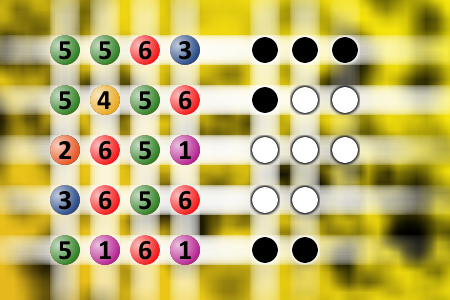
[2733] Find the right combination - The computer chose a secret code (sequence of 4 digits from 1 to 6). Your goal is to find that code. Black circles indicate the number of hits on the right spot. White circles indicate the number of hits on the wrong spot. - #brainteasers #mastermind - Correct Answers: 90 - The first user who solved this task is Sanja Šabović
BRAIN TEASERS
enter your answer and press button OK

Find the right combination

The computer chose a secret code (sequence of 4 digits from 1 to 6). Your goal is to find that code. Black circles indicate the number of hits on the right spot. White circles indicate the number of hits on the wrong spot.
Correct answers: 90
The first user who solved this task is Sanja Šabović.
#brainteasers #mastermind
Register with your Google Account and start collecting points.
Check your ranking on list.

A Prisoner's Last Request

Two men, sentenced to die on the same day, were led down to the room where the electric chair was. The priest had given them last rites, the formal speech had been given by the warden, and a final prayer had been said among the participants. The warden, turning to the first man, solemnly asked, "Son, do you have a last request?"The man replied, "Yes sir, I do. I love dance music. Could you please play the Macarena for me one last time?" "Certainly," replied the warden.He turned to the other man and asked, "Well, what about you, son? What is your final request?" "Please," said the condemned man, "Kill me first."
Jokes of the day - Daily updated jokes. New jokes every day.
Follow Brain Teasers on social networks

Brain Teasers

puzzles, riddles, mathematical problems, mastermind, cinemania...

William Rutter Dawes

Born 19 Mar 1799; died 15 Feb 1868 at age 68.English amateur astronomer who set up a private observatory and made extensive measurements of binary stars and on 25 Nov 1850 discovered Saturn's inner Crepe Ring (independently of American William Bond). In 1864, he was the first to make an accurate map of Mars. He was called "Eagle-eyed Dawes" for the keenness of his sight with a telescope (though otherwise, he was very near-sighted). He devised a useful empirical formula by which the resolving power of a telescope - known as the Dawes limit - could be quickly determined. For a given telescope with an aperture of d cm, a double star of separation 11/d arcseconds or more can be resolved, that is, be visually recognized as two stars rather than one.«
This site uses cookies to store information on your computer. Some are essential to help the site properly. Others give us insight into how the site is used and help us to optimize the user experience. See our privacy policy.