
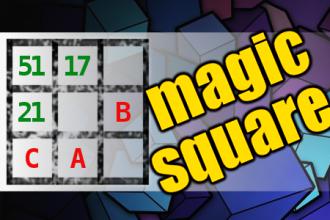
MAGIC SQUARE: Calculate A*B*C
[2771] MAGIC SQUARE: Calculate A*B*C - The aim is to place the some numbers from the list (12, 13, 16, 17, 18, 21, 29, 50, 51, 54, 71) into the empty squares and squares marked with A, B an C. Sum of each row and column should be equal. All the numbers of the magic square must be different. Find values for A, B, and C. Solution is A*B*C. - #brainteasers #math #magicsquare - Correct Answers: 43 - The first user who solved this task is Djordje Timotijevic
BRAIN TEASERS
enter your answer and press button OK

MAGIC SQUARE: Calculate A*B*C

The aim is to place the some numbers from the list (12, 13, 16, 17, 18, 21, 29, 50, 51, 54, 71) into the empty squares and squares marked with A, B an C. Sum of each row and column should be equal. All the numbers of the magic square must be different. Find values for A, B, and C. Solution is A*B*C.
Correct answers: 43
The first user who solved this task is Djordje Timotijevic.
#brainteasers #math #magicsquare

Register with your Google Account and start collecting points.
Check your ranking on list.

A woman places an ad in the lo...

A woman places an ad in the local newspaper. “Looking for a man with three qualifications: won’t beat me up, won’t run away from me, and is great in bed.” Two days later her doorbell rings. “Hi, I’m Tim. I have no arms so I won’t beat you, and no legs so I won't run away.” “What makes you think you are great in bed?” the woman retorts. Tim replies, “I rang the doorbell, didn’t I?”
Jokes of the day - Daily updated jokes. New jokes every day.
Follow Brain Teasers on social networks

Brain Teasers

puzzles, riddles, mathematical problems, mastermind, cinemania...

Sir D'Arcy Wentworth Thompson

Born 2 May 1860; died 21 Jun 1948 at age 88.Scottish zoologist and classical scholar, who is noted for his influential workOn Growth and Form (1917, new ed. 1942). It is a profound consideration of the shapes of living things, starting from the simple premise that “everything is the way it is because it got that way.”Hence one must study not only finished forms, but also the forces that moulded them: “the form of an object is a ‘diagram of forces’, in this sense, at least, that from it we can judge of or deduce the forces that are acting or have acted upon it.”' One of his great themes is the tremendous light cast on living things by using mathematics to describe their shapes and fairly simple physics and chemistry to explain them..
This site uses cookies to store information on your computer. Some are essential to help the site properly. Others give us insight into how the site is used and help us to optimize the user experience. See our privacy policy.