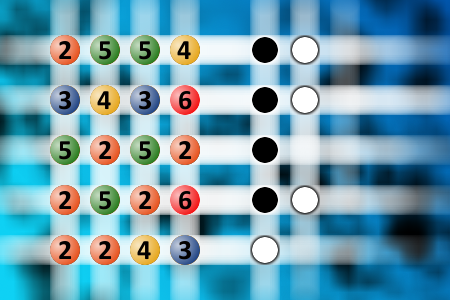
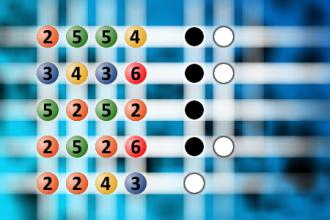
Find the right combination
[4410] Find the right combination - The computer chose a secret code (sequence of 4 digits from 1 to 6). Your goal is to find that code. Black circles indicate the number of hits on the right spot. White circles indicate the number of hits on the wrong spot. - #brainteasers #mastermind - Correct Answers: 30 - The first user who solved this task is Manguexa Wagle
BRAIN TEASERS
enter your answer and press button OK

Find the right combination

The computer chose a secret code (sequence of 4 digits from 1 to 6). Your goal is to find that code. Black circles indicate the number of hits on the right spot. White circles indicate the number of hits on the wrong spot.
Correct answers: 30
The first user who solved this task is Manguexa Wagle.
#brainteasers #mastermind
Register with your Google Account and start collecting points.
Check your ranking on list.

World Translation Day Jokes

On 30th September we celebrate World Translation Day! Find jokes about it below:

What do you call a translator who is always on time?

A punctual linguist.

A linguistics professor was lecturing his class the other day. “In English,” he said, “a double negative forms a positive.
However, in some languages, such as Russian, a double negative remains a negative. But there isn’t a single language, not one, in which a double positive can express a negative.”
A voice from the back of the room retorted, “Yeah, right.”

Two translators on a ship are talking.“Can you swim?” asks one.“No” says the other, “but I can shout for help in nine languages.”

#worldtranslationday
Jokes of the day - Daily updated jokes. New jokes every day.
Follow Brain Teasers on social networks

Brain Teasers

puzzles, riddles, mathematical problems, mastermind, cinemania...

Sir Richard Tetley Glazebrook

Died 15 Dec 1935 at age 81 (born 18 Sep 1854).English physicist who was the first director of the UK National Physical Laboratory, from 1 Jan 1900 until his retirement in Sep 1919. At first, the laboratory's income depended on much routine, commercial testing, but Glazebrook championed fundamental, industrially oriented research. With support from individual donors, buildings were added for electrical work, metrology, and engineering. Data useful to the shipbuilding industry was collected in pioneering experimental work on models of ships made possible by a tank funded by Alfred Yarrow (1908). From 1909, laboratory began work benefitting the embryonic aeronautics industry, at the request of the secretary of state for war. The lab to contributed substantially to military needs during WW I.«
This site uses cookies to store information on your computer. Some are essential to help the site properly. Others give us insight into how the site is used and help us to optimize the user experience. See our privacy policy.