Find the right combination
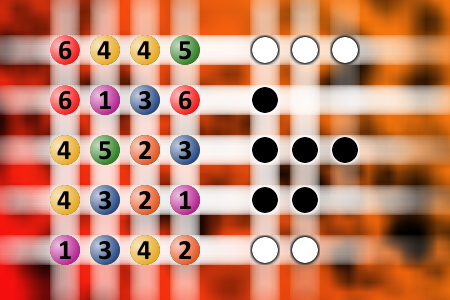
[4502] Find the right combination - The computer chose a secret code (sequence of 4 digits from 1 to 6). Your goal is to find that code. Black circles indicate the number of hits on the right spot. White circles indicate the number of hits on the wrong spot. - #brainteasers #mastermind - Correct Answers: 54 - The first user who solved this task is Djordje Timotijevic
BRAIN TEASERS
enter your answer and press button OK

Find the right combination

The computer chose a secret code (sequence of 4 digits from 1 to 6). Your goal is to find that code. Black circles indicate the number of hits on the right spot. White circles indicate the number of hits on the wrong spot.
Correct answers: 54
The first user who solved this task is Djordje Timotijevic.
#brainteasers #mastermind
Register with your Google Account and start collecting points.
Check your ranking on list.

Working On The Fourth Husband

A woman announces to her friend that she is getting married for the fourth time.
"How wonderful! But I hope you don't mind me asking what happened to your first husband?"

"He ate poisonous mushrooms and died."

"Oh, how tragic! What about your second husband?"

"He ate poisonous mushrooms too and died."

"Oh, how terrible! I'm almost afraid to ask you about your third husband."

"He died of a broken neck."

"A broken neck?"

"He wouldn't eat the mushrooms."

Jokes of the day - Daily updated jokes. New jokes every day.
Follow Brain Teasers on social networks

Brain Teasers

puzzles, riddles, mathematical problems, mastermind, cinemania...

Helium liquefied

In 1908, Kamerlingh Onnes made helium liquid at a temperature of 4.2 K (about -269 ºC). He had worked for many years to liquify this element which persisted as a gas to the lowest temperature. Using liquid air to produce liquid hydrogen and then the hydrogen to jacket the liquification apparatus, he produced about 60 cubic centimeters of liquid helium. The gas was liquefied by compressing it, cooling it below the inversion temperature and then allowing it to expand, which causes further cooling resulting in the liquefaction of some of the gas. At his cryogenic laboratory, he had previously liquefied air (1892) in large quantities, and built a large hydrogen liquefier (1906). Onnes received the Nobel Prize in 1913 for his low temperature work.
This site uses cookies to store information on your computer. Some are essential to help the site properly. Others give us insight into how the site is used and help us to optimize the user experience. See our privacy policy.