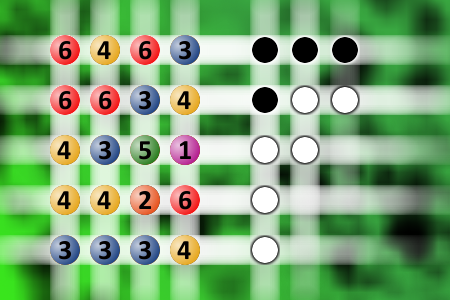
Find the right combination
[4757] Find the right combination - The computer chose a secret code (sequence of 4 digits from 1 to 6). Your goal is to find that code. Black circles indicate the number of hits on the right spot. White circles indicate the number of hits on the wrong spot. - #brainteasers #mastermind - Correct Answers: 57 - The first user who solved this task is Djordje Timotijevic
BRAIN TEASERS
enter your answer and press button OK

Find the right combination

The computer chose a secret code (sequence of 4 digits from 1 to 6). Your goal is to find that code. Black circles indicate the number of hits on the right spot. White circles indicate the number of hits on the wrong spot.
Correct answers: 57
The first user who solved this task is Djordje Timotijevic.
#brainteasers #mastermind
Register with your Google Account and start collecting points.
Check your ranking on list.

With no warning and clear out...

With no warning and clear out of the blue, a husband said to his wife, "Honey, I have invited a friend home for supper tonight."
His wife replied, "What? Are you crazy? The house is a mess, I didn't have time to go shopping, all the dishes are dirty, and I don't feel like cooking a fancy meal tonight!"
The husband said, "I know all that."
"Then why in the world did you invite your friend for supper tonight?" asked the wife.
The guy answered, "Because the poor fool is thinking about getting married."
Jokes of the day - Daily updated jokes. New jokes every day.
Follow Brain Teasers on social networks

Brain Teasers

puzzles, riddles, mathematical problems, mastermind, cinemania...

Zoopraxiscope

In 1882, the zoopraxiscope, an optical apparatus invented by Eadweard J. Muybridge (1879) to exhibit photographs of moving animals, was shown at the Royal Institution in the presence of the Prince of Wales. Muybridge's great work on the subject was published in 1887-9, and his Animals in Motion in 1899.* The zoopraxiscope projected images from rotating glass disks in rapid succession to give the impression of motion. It functioned as essentially the first movie projector, with a sequence of stop-motion silhouette images hand-painted around the edge of a circular glass disk, which was loaded onto the projector's side in a vertical position. In 1893, he lectured at "Zoopraxigraphical Hall" at the World's Columbian Exposition in Chicago.«[Image: Zoopraxiscope light source with chimney (left), glass disc (bottom alone, and right of centre mounted vertically). A large lens mounted for focussing the light beam stands on the right outside the picture.]
This site uses cookies to store information on your computer. Some are essential to help the site properly. Others give us insight into how the site is used and help us to optimize the user experience. See our privacy policy.