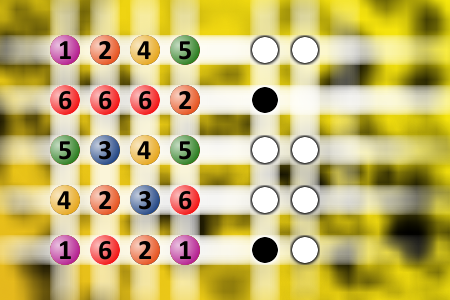
Find the right combination
[5138] Find the right combination - The computer chose a secret code (sequence of 4 digits from 1 to 6). Your goal is to find that code. Black circles indicate the number of hits on the right spot. White circles indicate the number of hits on the wrong spot. - #brainteasers #mastermind - Correct Answers: 29 - The first user who solved this task is Djordje Timotijevic
BRAIN TEASERS
enter your answer and press button OK

Find the right combination

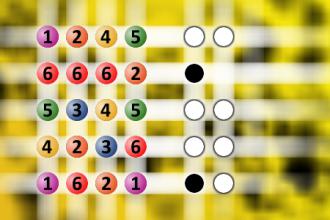
The computer chose a secret code (sequence of 4 digits from 1 to 6). Your goal is to find that code. Black circles indicate the number of hits on the right spot. White circles indicate the number of hits on the wrong spot.
Correct answers: 29
The first user who solved this task is Djordje Timotijevic.
#brainteasers #mastermind
Register with your Google Account and start collecting points.
Check your ranking on list.

Painting lines

A guy is hired to paint lines on a little country road, so the boss gives him a big can of paint, a brush and sends him out... At the end of the day, when he comes to get paid, he tells the boss he got two miles done. The boss is pretty impressed. At the end of the second day, the painter reports that he did half a mile. The boss is a little surprised at the drop, but thinks maybe the first-day enthusiasm just wore off. At the end of the third day, the painter reports that he did 400 yards. The boss says, "That's quite a difference from the first day." The painter replies, "Yeah, well it's a lot longer walk back to the paint can now."
Jokes of the day - Daily updated jokes. New jokes every day.
Follow Brain Teasers on social networks

Brain Teasers

puzzles, riddles, mathematical problems, mastermind, cinemania...

Sir Isaac Shoenberg

Died 25 Jan 1963 at age 82 (born 1 Mar 1880).Russian-Born British electrical engineer and principal inventor of the first high-definition television system, as used by the British Broadcasting Corporation (BBC) for the world's first public high-definition telecast (from London, 1936). He had installed the first radio stations in Russia before moving to England in 1914. He was head of a research group for Electrical and Musical Industries (EMI) that developed (1931-35) an advanced kind of camera tube (the Emitron) and a relatively efficient hard-vacuum cathode-ray tube for the television receiver. Until 1964 the BBC used his technical standard proposal - 405 scanning lines and 25 pictures a second. He was director of EMI from 1955. His youngest son, David Shoenberg, became a noted physicist.
This site uses cookies to store information on your computer. Some are essential to help the site properly. Others give us insight into how the site is used and help us to optimize the user experience. See our privacy policy.