Find the right combination
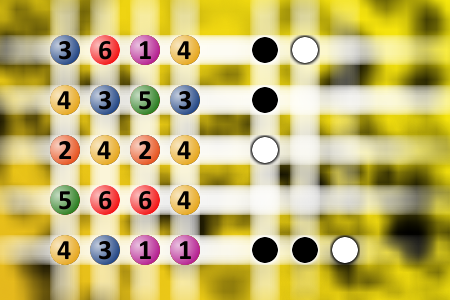
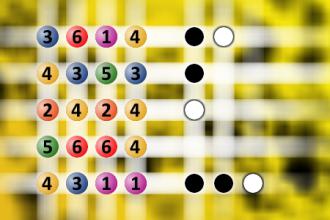
[5199] Find the right combination - The computer chose a secret code (sequence of 4 digits from 1 to 6). Your goal is to find that code. Black circles indicate the number of hits on the right spot. White circles indicate the number of hits on the wrong spot. - #brainteasers #mastermind - Correct Answers: 42 - The first user who solved this task is Djordje Timotijevic
BRAIN TEASERS
enter your answer and press button OK

Find the right combination

The computer chose a secret code (sequence of 4 digits from 1 to 6). Your goal is to find that code. Black circles indicate the number of hits on the right spot. White circles indicate the number of hits on the wrong spot.
Correct answers: 42
The first user who solved this task is Djordje Timotijevic.
#brainteasers #mastermind
Register with your Google Account and start collecting points.
Check your ranking on list.

Stay out of the dorms...

On the first day of college, the Dean addressed the students, pointing out some of the rules.

"The female dormitory will be out-of-bounds for all male students, and the male dormitory to the female students. Anybody caught breaking this rule will be fined $25 the first time."

He continued, "Anybody caught breaking this rule the second time will be fined $50. Being caught a third time will incur a hefty fine of $100. Are there any questions?"

At this point, a male student in the crowd inquired:

"How much for a season pass?"

Jokes of the day - Daily updated jokes. New jokes every day.
Follow Brain Teasers on social networks

Brain Teasers

puzzles, riddles, mathematical problems, mastermind, cinemania...

Belding H. Scribner

Born 18 Jan 1921; died 19 Jun 2003 at age 82.Belding Hibbard Scribner was an American physician who invented the Scribner shunt, making long-term kidney dialysis possible. The dialysis machine, which filters the blood of kidney disease patients, as originally developed by Dr. Willem J. Kolff, used glass tubes that were inserted into veins and arteries. These were painful and could not be used indefinitely because of progressive damage to the blood vessels. Scribner's key contribution (1960) was the shunt, a device implanted in a patient that allowed doctors to tap into their blood vessels and keep them on dialysis indefinitely. Scribner also led a team that developed the “artificial gut,”a method using a catheter to provide nourishment to patients who have lost their stomachs and intestines.
This site uses cookies to store information on your computer. Some are essential to help the site properly. Others give us insight into how the site is used and help us to optimize the user experience. See our privacy policy.