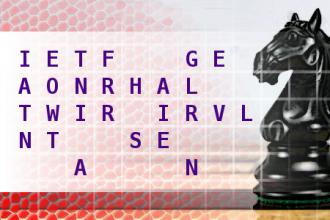
Chess Knight Move
[5200] Chess Knight Move - Find the title of novel, using the move of a chess knight. First letter is I. Length of words in solution: 2,2,1,7,5,1,9. - #brainteasers #wordpuzzles #chessknightmove - Correct Answers: 16 - The first user who solved this task is Djordje Timotijevic
BRAIN TEASERS
enter your answer and press button OK

Chess Knight Move

Find the title of novel, using the move of a chess knight. First letter is I. Length of words in solution: 2,2,1,7,5,1,9.
Correct answers: 16
The first user who solved this task is Djordje Timotijevic.
#brainteasers #wordpuzzles #chessknightmove
Register with your Google Account and start collecting points.
Check your ranking on list.

Enter a Password

A woman was helping her husband set up his computer, And at the appropriate point in the process. She told him that he would now need to enter a password, something he could remember easily and will use each time he has to log on.
The husband was in a rather amorous mood and figured he would try for the shock effect to bring this to his wife's attention. So, when the computer asked him to enter his password,
He made it plainly obvious to his wife that he was keying in....
P... E... N.... I... S...
His wife fell off her chair laughing when the computer replied:
***PASSWORD REJECTED. NOT LONG ENOUGH***

Jokes of the day - Daily updated jokes. New jokes every day.
Follow Brain Teasers on social networks

Brain Teasers

puzzles, riddles, mathematical problems, mastermind, cinemania...

Neil Bartlett

Died 5 Aug 2008 at age 75 (born 15 Sep 1932).English-American chemist who formed the first compound with a noble gas element, xenon platinofluoride, XePtF6 (23 Mar 1962), a yellow-orange crystalline solid, stable at room temperature by immersing platinum fluoride in xenon gas. For a half-century since Ramsay discovered xenon, it had, with the other elements in its group on the Periodic Table, been known as an inert gas. After Bartlett's discovery, a new field of investigation was opened, and other chemists found further compounds of not only xenon, but the noble gas elements radon and krypton. The heaviest elements of the noble gases, as the least inert, were susceptible to combination with a highly reactive element. Pauling had proposed this in theoretical calculations made thirty years before Bartlett's experimental success.«
This site uses cookies to store information on your computer. Some are essential to help the site properly. Others give us insight into how the site is used and help us to optimize the user experience. See our privacy policy.