Find the right combination
[7163] Find the right combination - The computer chose a secret code (sequence of 4 digits from 1 to 6). Your goal is to find that code. Black circles indicate the number of hits on the right spot. White circles indicate the number of hits on the wrong spot. - #brainteasers #mastermind - Correct Answers: 11
BRAIN TEASERS
enter your answer and press button OK

Find the right combination

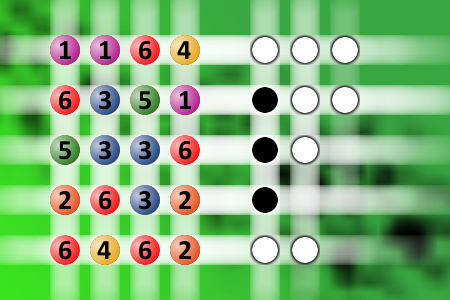
The computer chose a secret code (sequence of 4 digits from 1 to 6). Your goal is to find that code. Black circles indicate the number of hits on the right spot. White circles indicate the number of hits on the wrong spot.
Correct answers: 11
#brainteasers #mastermind
Register with your Google Account and start collecting points.
Check your ranking on list.

Nude Tiptoer

A woman who plays cards one night a month with a group of friends was concerned that she always woke up her husband when she came home around 11:30.

So she decided to be considerate and not rouse him this time. She undressed in the living room and, purse over arm, tiptoed nude into the bedroom, only to find him sitting up in bed, reading.

"Oh No!" he exclaimed. "Did you lose EVERYTHING?!?"

Jokes of the day - Daily updated jokes. New jokes every day.
Follow Brain Teasers on social networks

Brain Teasers

puzzles, riddles, mathematical problems, mastermind, cinemania...

Glass wool

In 1938, R. Games Slayter (died 15 Oct 1964) and John H. Thomas patent glass wool and the machinery to make it. Games Slayter, the driving force behind Owens Corning technology and innovation, sought to make a finer glass fiber material. In 1932, Dale Kleist, a young researcher under Jack Thomas (Slayter's research assistant), working on an unrelated experiment accidentally caused a jet of compressed air to strike a stream of molten glass, resulting in fine glass fibers. By Fall 1932, Kleist refined the process by using steam, to make glass fiber material thin enough for commercial fiber glass insulation. From March 1933, Games Slayter directed Jack Thomas in experiments using glass wool, instead of natural or other synthetic fibers, on textile machinery.
This site uses cookies to store information on your computer. Some are essential to help the site properly. Others give us insight into how the site is used and help us to optimize the user experience. See our privacy policy.