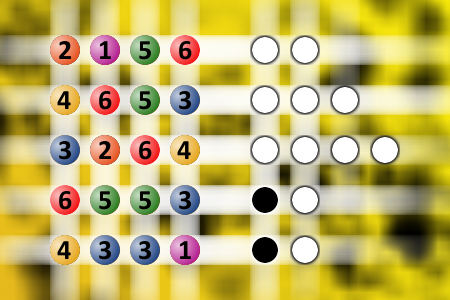
What a winning combination?
[8134] What a winning combination? - The computer chose a secret code (sequence of 4 digits from 1 to 6). Your goal is to find that code. Black circles indicate the number of hits on the right spot. White circles indicate the number of hits on the wrong spot. - #brainteasers #mastermind - Correct Answers: 0
BRAIN TEASERS
enter your answer and press button OK

What a winning combination?

The computer chose a secret code (sequence of 4 digits from 1 to 6). Your goal is to find that code. Black circles indicate the number of hits on the right spot. White circles indicate the number of hits on the wrong spot.
Correct answers: 0
#brainteasers #mastermind
Register with your Google Account and start collecting points.
Check your ranking on list.

Ponderings Collection 21

Who is General failure and why is he reading my disk ?
The light went out, but where to ?
Why do banks charge you a "non-sufficient funds fee" on money they already know you don't have?
Why is it you have a "pair" of pants and only one bra?
How come when I call Information they can't tell me where my keys are?
Why do people go to Burger King and Order a Double Whopper with a Large French Fry and insist on getting a Diet Coke?
Does the reverse side also have a reverse side?
Why is the alphabet in that order?
If the universe is everything, and scientists say that the universe is expanding, what is it expanding into?
If you got into a taxi and he started driving backwards, would the taxi driver end up owing you money?
Jokes of the day - Daily updated jokes. New jokes every day.
Follow Brain Teasers on social networks

Brain Teasers

puzzles, riddles, mathematical problems, mastermind, cinemania...

Martin Rodbell

Died 7 Dec 1998 at age 73 (born 1 Dec 1925).American biochemist who was awarded the 1994 Nobel Prize for Physiology or Medicine for his discovery in the 1960s of natural signal transducers called G-proteins that help cells in the body communicate with each other. He shared the prize with Alfred G. Gilman, who later proved Rodbell's hypothesis, by isolating the G-protein, which is so named because it binds to nucleotides called guanosine diphosphate and guanosine triphosphate, or GDP and GTP. Prior to Rodbell's research, scientists believed that only two substances—a hormone receptor and an interior cell enzyme—were responsible for cellular communication. Rodbell, however, discovered that the G-protein acted as an intermediate signal transducer between the two.
This site uses cookies to store information on your computer. Some are essential to help the site properly. Others give us insight into how the site is used and help us to optimize the user experience. See our privacy policy.