Find the right combination
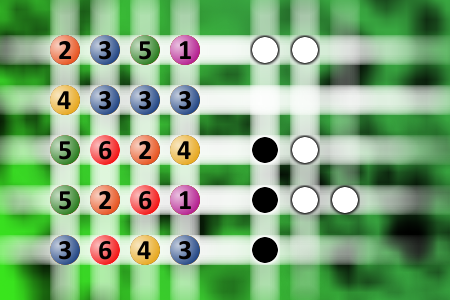
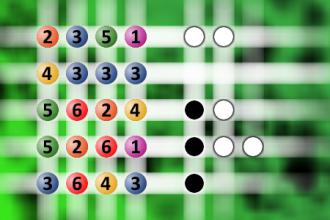
[7194] Find the right combination - The computer chose a secret code (sequence of 4 digits from 1 to 6). Your goal is to find that code. Black circles indicate the number of hits on the right spot. White circles indicate the number of hits on the wrong spot. - #brainteasers #mastermind - Correct Answers: 9
BRAIN TEASERS
enter your answer and press button OK

Find the right combination

The computer chose a secret code (sequence of 4 digits from 1 to 6). Your goal is to find that code. Black circles indicate the number of hits on the right spot. White circles indicate the number of hits on the wrong spot.
Correct answers: 9
#brainteasers #mastermind
Register with your Google Account and start collecting points.
Check your ranking on list.

Don't Let Me Be Late!

A little girl, dressed in her Sunday best, was running as fast as she could, trying not to be late for Bible class. As she ran, she prayed, "Dear Lord, please don't let me be late! Dear Lord, please don't let me be late!"

As she was running and praying, she tripped on a curb and fell, getting her clothes dirty and tearing her dress.

She got up, brushed herself off, and started running again. Again, she prayed, "Dear Lord, please don't let me be late!...But don't shove me either!"

Jokes of the day - Daily updated jokes. New jokes every day.
Follow Brain Teasers on social networks

Brain Teasers

puzzles, riddles, mathematical problems, mastermind, cinemania...

Alexander Agassiz

Born 17 Dec 1835; died 27 Mar 1910 at age 74.Alexander Emmanuel Rodolphe Agassiz was a Swiss marine zoologist, oceanographer and mining engineer who moved to the U.S. in 1849 to join his father, naturalist Jean Louis Agassiz, and studied at Harvard for degrees both in civil engineering (1857) and zoology (1862). Alexander Agassiz made important contributions to systematic zoology, to the knowledge of ocean beds, and to the development of the copper mines of Lake Superior (1866-9). He was curator of Harvard's Museum of Comparative Zoology (1873-85), founded by his father. He made numerous oceanographic zoological expeditions, wrote many books and examined thousands of coral reefs to refute Charles Darwin's ideas on atoll formation.
This site uses cookies to store information on your computer. Some are essential to help the site properly. Others give us insight into how the site is used and help us to optimize the user experience. See our privacy policy.