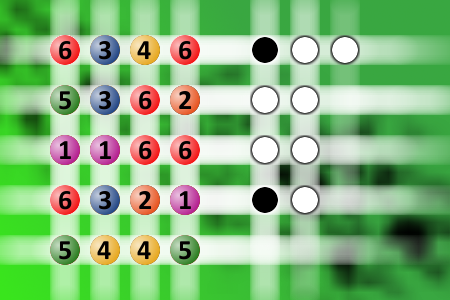

Find the right combination
[7201] Find the right combination - The computer chose a secret code (sequence of 4 digits from 1 to 6). Your goal is to find that code. Black circles indicate the number of hits on the right spot. White circles indicate the number of hits on the wrong spot. - #brainteasers #mastermind - Correct Answers: 11
BRAIN TEASERS
enter your answer and press button OK

Find the right combination

The computer chose a secret code (sequence of 4 digits from 1 to 6). Your goal is to find that code. Black circles indicate the number of hits on the right spot. White circles indicate the number of hits on the wrong spot.
Correct answers: 11
#brainteasers #mastermind
Register with your Google Account and start collecting points.
Check your ranking on list.

You Might Be A Redneck If ...

You might be a redneck if...
On your first date you had to ask your Dad to borrow the keys to the tractor.
Your parakeet knows the phrase "Open up, Police!"
You saved lots of money on your honeymoon by going deer hunting.
In tough situations you ask yourself, "What would Curly do?"
Taking your wife on a cruise means circling the Dairy Queen.
You think the last words to the Star Spangled Banner are "Play Ball..."
You have a color coordinating rope that ties down your car hood.
You bring your dog to work with you.
Your grandmother can correctly execute the sleeper hold.
You've ever held somebody up with a caulk gun.
Jokes of the day - Daily updated jokes. New jokes every day.
Follow Brain Teasers on social networks

Brain Teasers

puzzles, riddles, mathematical problems, mastermind, cinemania...

Wilhelm Waldeyer

Died 23 Jan 1921 at age 84 (born 6 Oct 1836). Heinrich Wilhelm Gottfried von Waldeyer-Hartz was a German anatomist who coined the terms neuron (1891) and chromosome (1888), and a number of embryological terms (including those to describe the structure of developing teeth). In 1856, he began university studies in natural science, but his interest turned to medicine and anatomy. After completing his doctoral dissertation (published 1862), he began teaching physiology, and thereafter published several papers on pathology. One of these, on the histological changes in muscles following typhoid fever, led at age 29 to appointment as a professor of pathology. He studied the diagnosis of early cancer, and in 1887 was one of the German doctors that diagnosed a tumor of his vocal cords for Emperor Frederick III. For over 30 years of his later career, until age 80, he was director of the anatomy department at the University of Berlin.«
This site uses cookies to store information on your computer. Some are essential to help the site properly. Others give us insight into how the site is used and help us to optimize the user experience. See our privacy policy.