Find the right combination
[7205] Find the right combination - The computer chose a secret code (sequence of 4 digits from 1 to 6). Your goal is to find that code. Black circles indicate the number of hits on the right spot. White circles indicate the number of hits on the wrong spot. - #brainteasers #mastermind - Correct Answers: 12
BRAIN TEASERS
enter your answer and press button OK

Find the right combination

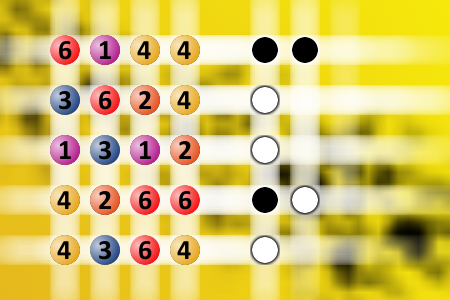
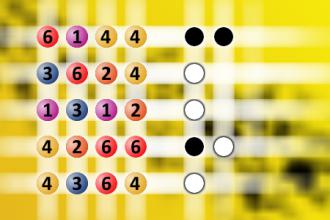
The computer chose a secret code (sequence of 4 digits from 1 to 6). Your goal is to find that code. Black circles indicate the number of hits on the right spot. White circles indicate the number of hits on the wrong spot.
Correct answers: 12
#brainteasers #mastermind
Register with your Google Account and start collecting points.
Check your ranking on list.

A guy fell asleep on the beach...

A guy fell asleep on the beach for several hours and got horrible sunburn, specifically to his upper legs. He went to the hospital, and was promptly admitted after being diagnosed with second-degree burns. With his skin already starting to blister, and the severe pain he was in, the doctor prescribed continuous intravenous feeding with saline, electrolytes, a sedative, and a Viagra pill every four hours.
The nurse, who was rather astounded, asked, "What good will Viagra do for him, Doctor?"
The doctor replied, "It won't do anything for his condition, but it'll keep the sheets off his legs."
Jokes of the day - Daily updated jokes. New jokes every day.
Follow Brain Teasers on social networks

Brain Teasers

puzzles, riddles, mathematical problems, mastermind, cinemania...

Lloyd Viel Berkner

Born 1 Feb 1905; died 4 Jun 1967 at age 62.American physicist and engineer who first measured the extent, including height and density, of the ionosphere (ionized layers of the Earth's atmosphere), leading to a complete understanding of radio wave propagation and he helped develop radar systems, especially the Distant Early Warning system. He later investigated the origin and development of the Earth's atmosphere. Early in his career, he worked on radio navigation beacons for the Airways division of the Bureau of Lighthouses (1927-28), as radio engineer on the Byrd Antarctic expedition (1928-30). Returning to the U.S. Bureau of Standards (1930-33) he studied the ionosphere using radio-pulse transmissions, then terrestrial magnetism with the Carnegie Institution (1933-51).
This site uses cookies to store information on your computer. Some are essential to help the site properly. Others give us insight into how the site is used and help us to optimize the user experience. See our privacy policy.