Find the right combination
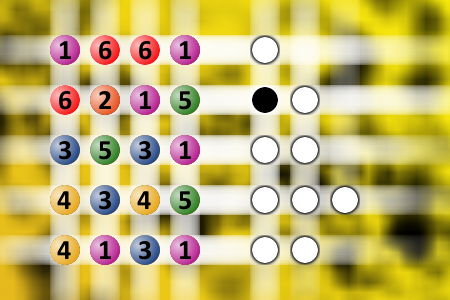
[7327] Find the right combination - The computer chose a secret code (sequence of 4 digits from 1 to 6). Your goal is to find that code. Black circles indicate the number of hits on the right spot. White circles indicate the number of hits on the wrong spot. - #brainteasers #mastermind - Correct Answers: 5
BRAIN TEASERS
enter your answer and press button OK

Find the right combination

The computer chose a secret code (sequence of 4 digits from 1 to 6). Your goal is to find that code. Black circles indicate the number of hits on the right spot. White circles indicate the number of hits on the wrong spot.
Correct answers: 5
#brainteasers #mastermind
Register with your Google Account and start collecting points.
Check your ranking on list.

Things t...

Things to say to the boss to get you fired:

"I see you've set aside this special time to humiliate yourself in public."

"I like you. You remind me of when I was young and stupid."

"Not the brightest crayon in the box now, are you?"

"Who me? I just wander from room to room."

"I pretend to work. You pretend to pay me."

"Did the aliens forget to remove your anal probe?"

"Aw, did I step on your poor little bitty ego?"

"Earth is full, go home!"

"How about 'never'? Is 'never' good for you?"

"Any connection between your reality and mine is purely coincidental."
Jokes of the day - Daily updated jokes. New jokes every day.
Follow Brain Teasers on social networks

Brain Teasers

puzzles, riddles, mathematical problems, mastermind, cinemania...

Caspar Wessel

Died 25 Mar 1818 at age 72 (born 8 Jun 1745).Norwegian surveyor and mathematician who demonstrated innovative mathematical skills as a surveyor, mathematically processing the triangulation data and preparing maps. From 1764, he worked for the Royal Danish Academy, which was making a topographical survey of Denmark. In his life career, Caspar advanced his knowledge of algebra, trigonometry and mathematical geometry. On 10 Mar 1797, he presented his only mathematical paper to the Academy, containing the first geometric representation of complex numbers, but it wasn't seen internationally. Jean-Robert Argand, found the method independently, and his publication (1806) was circulated, hence the method is known as an Argand diagram. A complex numbers is shown as a point in a Cartesian plane, with the real portion of the number on the x axis and the imaginary part on the y axis.«[Image: An Argand diagram, known by that name, but priority goes to Wessel.]
This site uses cookies to store information on your computer. Some are essential to help the site properly. Others give us insight into how the site is used and help us to optimize the user experience. See our privacy policy.