Find the right combination
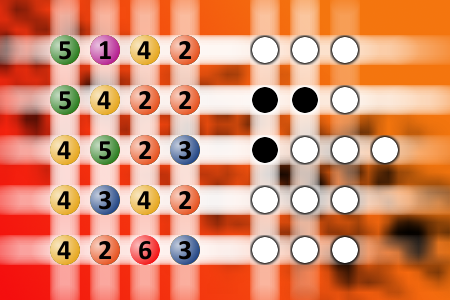
[7431] Find the right combination - The computer chose a secret code (sequence of 4 digits from 1 to 6). Your goal is to find that code. Black circles indicate the number of hits on the right spot. White circles indicate the number of hits on the wrong spot. - #brainteasers #mastermind - Correct Answers: 3
BRAIN TEASERS
enter your answer and press button OK

Find the right combination

The computer chose a secret code (sequence of 4 digits from 1 to 6). Your goal is to find that code. Black circles indicate the number of hits on the right spot. White circles indicate the number of hits on the wrong spot.
Correct answers: 3
#brainteasers #mastermind
Register with your Google Account and start collecting points.
Check your ranking on list.

Tour Bus Driver

A tour bus driver is driving with a bus full of old aged pensioners when he is tapped on his shoulder by a little old lady.
She offers him a handful of peanuts, which he gratefully munches up.
After about 15 minutes, she taps him on the shoulder again and she hands the driver another handful of peanuts.
When she is about to hand him another batch again, he asks her "Why don't you eat the peanuts?"
"We can't chew them because we have no teeth", she replied.
"We just love the chocolate around them."

Jokes of the day - Daily updated jokes. New jokes every day.
Follow Brain Teasers on social networks

Brain Teasers

puzzles, riddles, mathematical problems, mastermind, cinemania...

Brain surgery

In 1923, the first operation to remove a brain tumour under local anesthetic (cocaine on the patient's scalp) was performed at Beth Israel Hospital in New York City by a team of surgeons led by Dr. Karl Winfield Ney (d. 31 May 1949). The 4"x2"x¾" tumour was benign, but still life-threatening. The patient's condition had been deemed too risky for a general anaesthetic. So Henry A. Brown was fully conscious throughout the operation and able to answer the doctors' questions. Ney was a one-time chief of surgery for the French Red Cross. He served in the U.S. Army Medical Corps from 1917 to 1921. «*
This site uses cookies to store information on your computer. Some are essential to help the site properly. Others give us insight into how the site is used and help us to optimize the user experience. See our privacy policy.