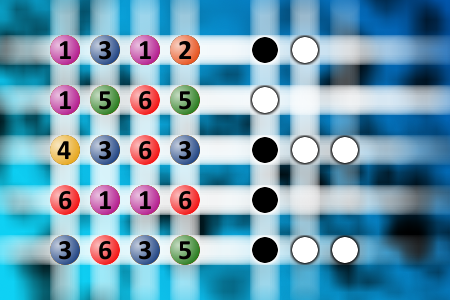
Find the right combination
[7435] Find the right combination - The computer chose a secret code (sequence of 4 digits from 1 to 6). Your goal is to find that code. Black circles indicate the number of hits on the right spot. White circles indicate the number of hits on the wrong spot. - #brainteasers #mastermind - Correct Answers: 6
BRAIN TEASERS
enter your answer and press button OK

Find the right combination

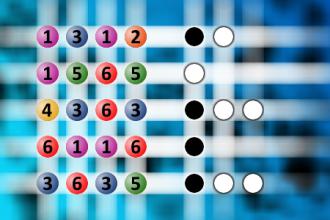
The computer chose a secret code (sequence of 4 digits from 1 to 6). Your goal is to find that code. Black circles indicate the number of hits on the right spot. White circles indicate the number of hits on the wrong spot.
Correct answers: 6
#brainteasers #mastermind
Register with your Google Account and start collecting points.
Check your ranking on list.

It Takes A Long Time

Janice, my sister, had been pestering her husband, a carpenter, for more than a decade to build a screen door for the kitchen.
One day, to her delight, he built and installed one in less than two hours. It was both practical and pretty. She glanced towards the front door and wistfully remarked that one would look good there, as well.
"Are you kidding?" he gasped. "You can't just whip these things up, you know. It takes ten years to build a door like this."

Jokes of the day - Daily updated jokes. New jokes every day.
Follow Brain Teasers on social networks

Brain Teasers

puzzles, riddles, mathematical problems, mastermind, cinemania...

Lars V. Hörmander

Born 24 Jan 1931.Swedish mathematician who was awarded the Fields Medal in 1962 for his work on partial differential equations. Spending five years in writing, he produced a text The analysis of linear partial differential operators, in four volumes (1983-85). Between 1987 and 1990 he served as a vice president of the International Mathematical Union. In 1988 Hörmander was awarded the Wolf Prize. Hörmander's text, An Introduction to Complex Analysis in Several Variables, has become a classic dealing with the theory of functions of several complex variables. It developed from lecture notes of a course which he gave in Stanford in 1964 and published in book form two years later, with updates in 1973 and 1990.
This site uses cookies to store information on your computer. Some are essential to help the site properly. Others give us insight into how the site is used and help us to optimize the user experience. See our privacy policy.