
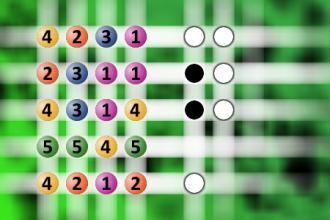
Find the right combination
[7470] Find the right combination - The computer chose a secret code (sequence of 4 digits from 1 to 6). Your goal is to find that code. Black circles indicate the number of hits on the right spot. White circles indicate the number of hits on the wrong spot. - #brainteasers #mastermind - Correct Answers: 3
BRAIN TEASERS
enter your answer and press button OK

Find the right combination

The computer chose a secret code (sequence of 4 digits from 1 to 6). Your goal is to find that code. Black circles indicate the number of hits on the right spot. White circles indicate the number of hits on the wrong spot.
Correct answers: 3
#brainteasers #mastermind
Register with your Google Account and start collecting points.
Check your ranking on list.

The pickle slicer

Bill worked in a pickle factory. He had been employed there for many years when he came home one day to confess to his wife that he had a terrible compulsion. He had an urge to stick his penis into the pickle slicer.

His wife suggested that he should see a sex therapist to talk about it, but Bill said he would be too embarrassed. He vowed to overcome the compulsion on his own.

One day a few weeks later, Bill came home and his wife could see at once that something was seriously wrong.

"What's wrong, Bill?" she asked.

"Do you remember that I told you how I had this tremendous urge to put my penis into the pickle slicer?"

"Oh, Bill, you didn't!" she exclaimed.

"Yes, I did," he replied.

"My God, Bill, what happened?" she asked.

"I got fired," he replied.

"No, Bill. I mean, what happened with the pickle slicer?" she demanded.

"Oh... she got fired too."

Jokes of the day - Daily updated jokes. New jokes every day.
Follow Brain Teasers on social networks

Brain Teasers

puzzles, riddles, mathematical problems, mastermind, cinemania...

Elastic bands patent

In 1845, a method of manufacturing elastic (rubber) bands was patented in Britain by Stephen Perry and and Thomas Barnabas Daft of London (G.B. No. 13880/1845). In the early 19th century, sailors brought home items made by Central and South American natives from the sap of rubber trees, including footwear, garments and bottles. Around 1820, a Londoner named Thomas Hancock sliced up one of the bottles to create garters and waistbands. By 1843, he had secured patent rights from Charles Macintosh for vulcanized india rubber. Stephen Perry, owner of Messrs Perry and Co,. patented the use of india rubber for use as springs in bands, belts, etc., and also the manufacture of elastic bands by slicing suitable sizes of vulcanized india rubber tube. Vulcanization made rubber stable and retain its elasticity.«[Image: from 1882 Perry & Co. catalog. Elastic bands are known as rubber bands in the U.S.]
This site uses cookies to store information on your computer. Some are essential to help the site properly. Others give us insight into how the site is used and help us to optimize the user experience. See our privacy policy.