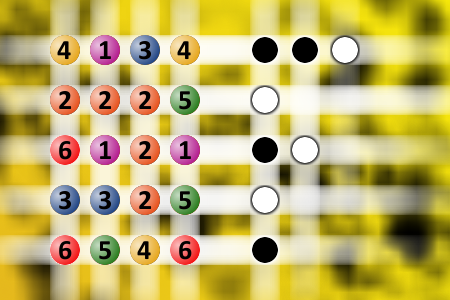
Find the right combination
[7682] Find the right combination - The computer chose a secret code (sequence of 4 digits from 1 to 6). Your goal is to find that code. Black circles indicate the number of hits on the right spot. White circles indicate the number of hits on the wrong spot. - #brainteasers #mastermind - Correct Answers: 2
BRAIN TEASERS
enter your answer and press button OK

Find the right combination

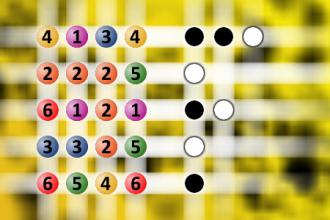
The computer chose a secret code (sequence of 4 digits from 1 to 6). Your goal is to find that code. Black circles indicate the number of hits on the right spot. White circles indicate the number of hits on the wrong spot.
Correct answers: 2
#brainteasers #mastermind
Register with your Google Account and start collecting points.
Check your ranking on list.

A lady walks into the drug sto...

A lady walks into the drug store and asks the druggist for some arsenic.
The druggist asks, "Ma'am, what do you want with arsenic?"
The lady says, "To kill my husband."
"I can't sell you any for that reason," says the druggist.
The lady then reaches into her purse and pulls out a photo of a man and a woman in a compromising position, the man is her husband and the lady is the druggist's wife, and shows it to the druggist.
He looks at the photo and says, "Oh I didn't know you had a prescription!"
Jokes of the day - Daily updated jokes. New jokes every day.
Follow Brain Teasers on social networks

Brain Teasers

puzzles, riddles, mathematical problems, mastermind, cinemania...

Brook Taylor

Died 29 Dec 1731 at age 46 (born 18 Aug 1685).British mathematician, best known for the Taylor's series, a method for expanding functions into infinite series. In 1708, Taylor produced a solution to the problem of the centre of oscillation. His Methodus incrementorum directa et inversa (“Direct and Indirect Methods of Incrementation,” 1715) introduced what is now called the calculus of finite differences. Using this, he was the first to express mathematically the movement of a vibrating string on the basis of mechanical principles. Methodus also contained Taylor's theorem, later recognized (1772) by Joseph Lagrange as the basis of differential calculus. A gifted artist, Taylor also wrote on basic principles of perspective (1715) containing the first general treatment of the principle of vanishing points.«
This site uses cookies to store information on your computer. Some are essential to help the site properly. Others give us insight into how the site is used and help us to optimize the user experience. See our privacy policy.