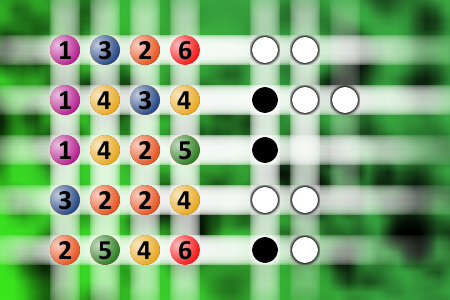
Find the right combination
[7793] Find the right combination - The computer chose a secret code (sequence of 4 digits from 1 to 6). Your goal is to find that code. Black circles indicate the number of hits on the right spot. White circles indicate the number of hits on the wrong spot. - #brainteasers #mastermind - Correct Answers: 3
BRAIN TEASERS
enter your answer and press button OK

Find the right combination

The computer chose a secret code (sequence of 4 digits from 1 to 6). Your goal is to find that code. Black circles indicate the number of hits on the right spot. White circles indicate the number of hits on the wrong spot.
Correct answers: 3
#brainteasers #mastermind

Register with your Google Account and start collecting points.
Check your ranking on list.

The recital

A soldier stationed in the South Pacific wrote to his wife in the States to please send him a harmonica to occupy his free time and keep his mind off of the local women. The wife complied and sent the best one she could find, along with several dozen lesson & music books.

Rotated back home, he rushed to their home and thru the front door. "Oh darling" he gushed, "Come here... let me look at you... let me hold you ! Let's have a fine dinner out, then make love all night. I've missed your lovin' so much !" The wife, keeping her distance, said, "All in good time lover. First, let's hear you play that harmonica."

Jokes of the day - Daily updated jokes. New jokes every day.
Follow Brain Teasers on social networks

Brain Teasers

puzzles, riddles, mathematical problems, mastermind, cinemania...

Martin Perl

Born 24 Jun 1927; died 30 Sep 2014 at age 87. Martin Lewis Perl was an American physicist who received the 1995 Nobel Prize for Physics for discovering a subatomic particle that he named the tau, a massive lepton with a negative charge. The tau, which he found in the mid-1970s, was the first evidence of a third “generation” of fundamental particles. It is a superheavy cousin of the electron, identical in all respects except that the tau is more than 3,500 times heavier than the electron and survives less than a trillionth of a second, whereas the electron is stable.
This site uses cookies to store information on your computer. Some are essential to help the site properly. Others give us insight into how the site is used and help us to optimize the user experience. See our privacy policy.