Find the right combination
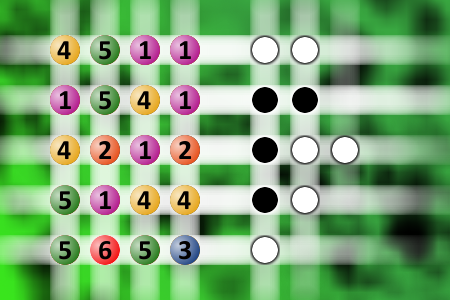
[7963] Find the right combination - The computer chose a secret code (sequence of 4 digits from 1 to 6). Your goal is to find that code. Black circles indicate the number of hits on the right spot. White circles indicate the number of hits on the wrong spot. - #brainteasers #mastermind - Correct Answers: 1
BRAIN TEASERS
enter your answer and press button OK

Find the right combination

The computer chose a secret code (sequence of 4 digits from 1 to 6). Your goal is to find that code. Black circles indicate the number of hits on the right spot. White circles indicate the number of hits on the wrong spot.
Correct answers: 1
#brainteasers #mastermind
Register with your Google Account and start collecting points.
Check your ranking on list.

Lightbulb Joke Collection 40

Q: How many body builders/weightlifters does it take to change a lightbulb ?

A: 6. One to change it and 5 to say "Man, you've got huge muscles !"


Q: How many Sun readers does it take to screw in a light bulb?

A: 10. One to hold the bulb and nine to rotate the ladder.


Q: How many Sun readers does it take to screw in a light bulb?

A: None, but one is enough to screw up the joke.


Q: How many blondes does it take to change a lightbulb ?

A: Duh.... whats a lightbulb???


Q: How many blondes does it take to change a lightbulb ?

A: It depends how many blondes there are, but some people prefer it with the lights off.


Q: How many poltergeists does it take to change a lightbulb ?

A: Three. One to unscrew the old bulb and drop it on the floor, one to put the new bulb in, and one to move a few more things about just for good measure.


Q: How many nihilists does it take to change a light bulb?

A: There is nothing to change.


Q: How many fatalists does it take to screw in a light bulb?

A: Sod it, we're all gonna die anyway.


Jokes of the day - Daily updated jokes. New jokes every day.
Follow Brain Teasers on social networks

Brain Teasers

puzzles, riddles, mathematical problems, mastermind, cinemania...

John Ray

Died 17 Jan 1705 at age 77 (born 29 Nov 1627). English naturalist and botanist who was a leader in his field during the 17th-century English and contributed significantly to progress in taxonomy, and is often referred to as the father of natural history in Britain. He toured Europe with Francis Willoughby in search of specimens of flora and fauna. Ray was the first to classify flowering plants into monocotyledons and dicotyledons. Ray established the species as the basic taxonomic unit - his enduring legacy to botany. His major work was the three-volume Historia Plantarum (1686-1704). He also attempted to classify the animal kingdom. In 1693 he published a system based on a number of structural characters, including internal anatomy, which provided a more natural classification than those being produced by his contemporaries.
This site uses cookies to store information on your computer. Some are essential to help the site properly. Others give us insight into how the site is used and help us to optimize the user experience. See our privacy policy.