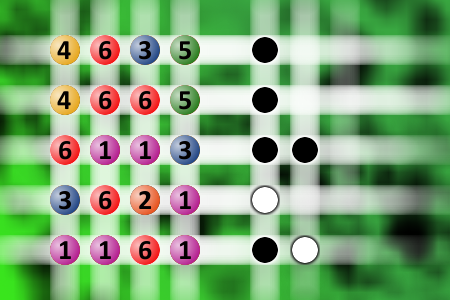
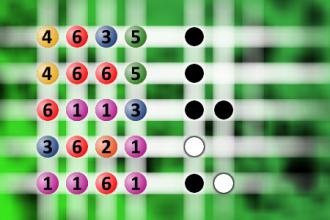
Find the right combination
[8026] Find the right combination - The computer chose a secret code (sequence of 4 digits from 1 to 6). Your goal is to find that code. Black circles indicate the number of hits on the right spot. White circles indicate the number of hits on the wrong spot. - #brainteasers #mastermind - Correct Answers: 2
BRAIN TEASERS
enter your answer and press button OK

Find the right combination

The computer chose a secret code (sequence of 4 digits from 1 to 6). Your goal is to find that code. Black circles indicate the number of hits on the right spot. White circles indicate the number of hits on the wrong spot.
Correct answers: 2
#brainteasers #mastermind
Register with your Google Account and start collecting points.
Check your ranking on list.

Thanksgiving

A man went one Thanksgiving to get a turkey from a live poultry farm. "Do you have any turkeys going cheap?" he asked."Nope," said the owner. "All our turkey go gobble, gobble.'"
Q: Why can't you take a turkey to church?
A: Because they use fowl language.
Q: What's the most musical part of a turkey?
A: The drumstick.
Q: Which cat discovered America?
A: Christofurry Columbus.
Jokes of the day - Daily updated jokes. New jokes every day.
Follow Brain Teasers on social networks

Brain Teasers

puzzles, riddles, mathematical problems, mastermind, cinemania...

Hugh L. Dryden

Died 2 Dec 1965 at age 67 (born 2 Jul 1898). Hugh Latimer Dryden was an American physicistand deputy administrator of the National Aeronautics and Space Administration (NASA, 1958) for 7 years. He made pioneering studies in the aerodynamics of high speed and some of the earliest studies of air flow around wing surfaces at the speed of sound. During WW II he headed the Washington Project of the National Defense Research Committee, which developed the Bat radar-homing missile, the first successful U.S. guided missile, which was used by the navy against the Japanese during WW II. In 1962, he led negotiations for joint U.S.-Soviet space projects. He was instrumental in achieving the exchange of weather-satellite data and operation of cooperative communications satellite tests.
This site uses cookies to store information on your computer. Some are essential to help the site properly. Others give us insight into how the site is used and help us to optimize the user experience. See our privacy policy.