Find the right combination
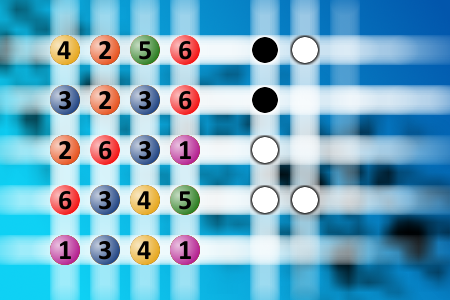
[8033] Find the right combination - The computer chose a secret code (sequence of 4 digits from 1 to 6). Your goal is to find that code. Black circles indicate the number of hits on the right spot. White circles indicate the number of hits on the wrong spot. - #brainteasers #mastermind - Correct Answers: 1
BRAIN TEASERS
enter your answer and press button OK

Find the right combination

The computer chose a secret code (sequence of 4 digits from 1 to 6). Your goal is to find that code. Black circles indicate the number of hits on the right spot. White circles indicate the number of hits on the wrong spot.
Correct answers: 1
#brainteasers #mastermind
Register with your Google Account and start collecting points.
Check your ranking on list.

The photographer for a nationa...

The photographer for a national magazine was assigned to get photos of an enormous forest fire. Smoke at the scene was too thick to get any good shots, so he frantically called his home office to hire a plane. 
"It will be waiting for you at the airport!" he was assured by his editor. 
As soon as he got to the small, rural airport, sure enough, a plane was warming up near the runway. He jumped in with his equipment and yelled, "Let's go! Let's go!" The pilot swung the plane into the wind and soon they were in the air. 
"Fly over the north side of the fire," said the photographer, "and make three or four low level passes." 
"Why?" asked the pilot. 
"Because I'm going to take pictures! I'm a photographer, and photographers take pictures!" said the photographer with great exasperation and impatience. 
After a long pause the pilot said, "You mean you're not the instructor?" 
Jokes of the day - Daily updated jokes. New jokes every day.
Follow Brain Teasers on social networks

Brain Teasers

puzzles, riddles, mathematical problems, mastermind, cinemania...

Haldan Keffer Hartline

Born 22 Dec 1903; died 17 Mar 1983 at age 79.American physiologist who shared (with George Wald and Ragnar Granit) the 1967 Nobel Prize for Physiology or Medicine for his analysis of how the sensory cells of the retina of the eye evaluate the light stimulus. In his early career, he studied the metabolism of nerve cells and in time came to research individual cells in the retina of the eye. He used tiny electrodes to isolate individual fibres in the eyes of horseshoe crabs and frogs. He learned how impulse generation in the sensory cells transmits a code in response to illumination of different intensity and duration. He spent almost half a century advancing the understanding of the neurophysiology of vision.«
This site uses cookies to store information on your computer. Some are essential to help the site properly. Others give us insight into how the site is used and help us to optimize the user experience. See our privacy policy.