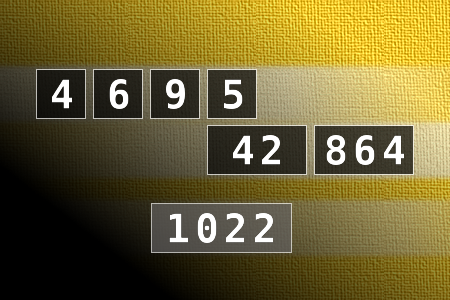

Calculate the number 1022
[8046] Calculate the number 1022 - NUMBERMANIA: Calculate the number 1022 using numbers [4, 6, 9, 5, 42, 864] and basic arithmetic operations (+, -, *, /). Each of the numbers can be used only once. - #brainteasers #math #numbermania - Correct Answers: 1
BRAIN TEASERS
enter your answer and press button OK

Calculate the number 1022

NUMBERMANIA: Calculate the number 1022 using numbers [4, 6, 9, 5, 42, 864] and basic arithmetic operations (+, -, *, /). Each of the numbers can be used only once.
Correct answers: 1
#brainteasers #math #numbermania
Register with your Google Account and start collecting points.
Check your ranking on list.

A gynecologist who had lost in...

A gynecologist who had lost interest in his medical practice decided to change careers and enrolled in auto mechanic school.
He performed well in the course but was still shocked when he got an off-the-chart 200 on his final exam. He asked the instructor to explain the grade.
"I gave you 50 points for taking the engine apart correctly," the teacher said, "50 points for putting it back together correctly -- and an extra 100 points for doing it all through the muffler."
Jokes of the day - Daily updated jokes. New jokes every day.
Follow Brain Teasers on social networks

Brain Teasers

puzzles, riddles, mathematical problems, mastermind, cinemania...

Ian Donald

Died 19 Jun 1987 at age 76 (born 27 Dec 1910). English physician who first successfully applied ultrasound reflection imaging for medical diagnosis. He had become familiar with sonar during service in WW II, and first tested the idea of probing organs with ultrasound on 21 Jul 1955, when he investigated specimens of tumours from human organs with an industrial ultrasonic metal flaw detector. After a period of development, he later he used ultrasound in a life-saving diagnosis of a huge, easily removable, ovarian cyst in a woman who had been diagnosed by others as having inoperable stomach cancer. He published the Investigation of Abdominal Masses by Pulsed Ultrasound in The Lancet (7 Jun 1958). The next year, he extended its use to investigate fetal growth during pregnancy.«*
This site uses cookies to store information on your computer. Some are essential to help the site properly. Others give us insight into how the site is used and help us to optimize the user experience. See our privacy policy.