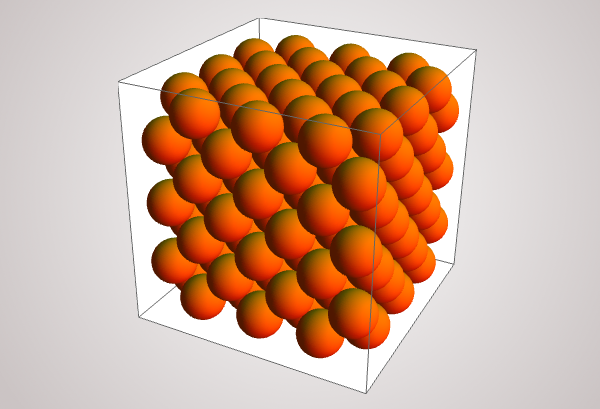
How many balls are there?
[2598] How many balls are there? - How many balls are there? - #brainteasers #math #riddles - Correct Answers: 73 - The first user who solved this task is Jasmina Atarac-Pantelic
BRAIN TEASERS
enter your answer and press button OK

How many balls are there?

How many balls are there?
Correct answers: 73
The first user who solved this task is Jasmina Atarac-Pantelic.
#brainteasers #math #riddles
Register with your Google Account and start collecting points.
Check your ranking on list.

Little Johnny was sitting in c...

Little Johnny was sitting in class doing math problems when his teacher picked him to answer a question:

"Johnny, if there were five birds sitting on a fence and you shot one with your gun, how many would be left ?"

"None.", replied Johnny. "'cause the rest would fly off."

"The correct answer is four," said the teacher. "But I like your thinking."

Little Johnny said, "I have a question for you now. If there were three women eating ice cream cones in a shop, one licking her cone, the second biting her cone, and the third one sucking her cone, which one is married ?

"Well," said the teacher nervously, "I guess the one sucking her cone?"

"No," said Little Johnny, "The one with the wedding ring on her finger. But I like the way you think!"
Jokes of the day - Daily updated jokes. New jokes every day.
Follow Brain Teasers on social networks

Brain Teasers

puzzles, riddles, mathematical problems, mastermind, cinemania...

Chondrite meteor

In 1806, a 6-kg chondrite meteorite - carrying carbon-based, organic chemicals - was unequivocally identified for the first time. Its arrival on earth was noted at 5:30 pm, outside Alais, France. The organic chemicals it carried suggested the possibility of life on whatever body was the source, somewhere in the universe. According to the observations of Berzelius and a commission appointed by the French Academy it “emits a faint bituminous substance” when heated. Berzelius reported his analysis of the Alais meteorite in 1833 that destructive distillation yielded a blackish substance, indiginous water, carbon dioxide gas, a soluble salt containing ammonia, and a blackish-brown sublimate, which Berzelius confessed was unknown to him.
This site uses cookies to store information on your computer. Some are essential to help the site properly. Others give us insight into how the site is used and help us to optimize the user experience. See our privacy policy.