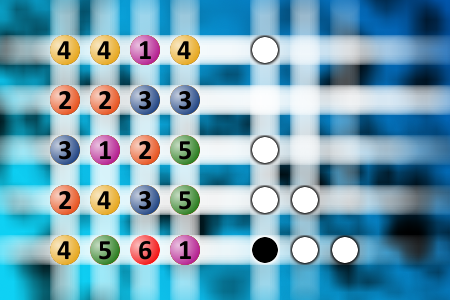

Which is a winning combination of digits?
[6828] Which is a winning combination of digits? - The computer chose a secret code (sequence of 4 digits from 1 to 6). Your goal is to find that code. Black circles indicate the number of hits on the right spot. White circles indicate the number of hits on the wrong spot. - #brainteasers #mastermind - Correct Answers: 33 - The first user who solved this task is Nasrin 24 T
BRAIN TEASERS
enter your answer and press button OK

Which is a winning combination of digits?

The computer chose a secret code (sequence of 4 digits from 1 to 6). Your goal is to find that code. Black circles indicate the number of hits on the right spot. White circles indicate the number of hits on the wrong spot.
Correct answers: 33
The first user who solved this task is Nasrin 24 T.
#brainteasers #mastermind
Register with your Google Account and start collecting points.
Check your ranking on list.

A couple was making their firs...

A couple was making their first doctors visit prior to the birth of their first child. After the exam, the doctor took a small stamp and stamped the wife’s stomach with indelible ink. The man and his wife were curious about what the stamp was for, so when they got home, the man took out his magnifying glass to try to see what is was. In very small letters, the stamp said, “When you can read this, come back and see me.”
Jokes of the day - Daily updated jokes. New jokes every day.
Follow Brain Teasers on social networks

Brain Teasers

puzzles, riddles, mathematical problems, mastermind, cinemania...

Bernhard Bolzano

Born 5 Oct 1781; died 18 Dec 1848 at age 67. Czech mathematician and theologian who made significant contributions to both mathematics and the theory of knowledge. He provided a more detailed proof for the binomial theorem in 1816 and suggested the means of distinguishing between finite and infinite classes. Bolzano helped to establish the foundations of analysis (for example, the Bolzano-Weierstrass theorem), attempted to elaborate mathematical method, and anticipated some basic ideas of Cantor's set theory. His major work, Wissenschaftslehre (1837), contains various contributions to logic and semantics concerning the relations of compatibility, derivability, and consequence, the deduction theorem, and the logic of classes, entailment, and probability.Name also spelled Bernard.
This site uses cookies to store information on your computer. Some are essential to help the site properly. Others give us insight into how the site is used and help us to optimize the user experience. See our privacy policy.