How many times can you subtr...
[2344] How many times can you subtr... - How many times can you subtract the number 5 from 25? - #brainteasers #math #riddles - Correct Answers: 129 - The first user who solved this task is Djordje Timotijevic
BRAIN TEASERS
enter your answer and press button OK

How many times can you subtr...

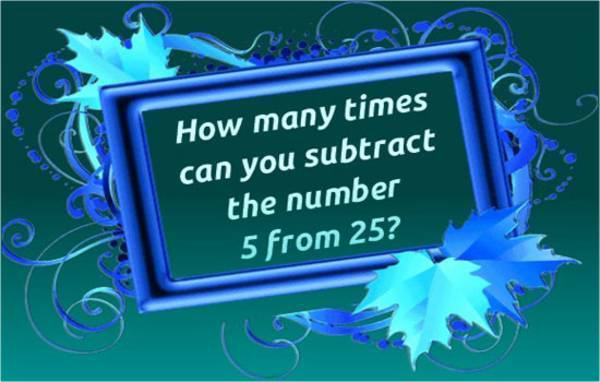
How many times can you subtract the number 5 from 25?
Correct answers: 129
The first user who solved this task is Djordje Timotijevic.
#brainteasers #math #riddles
Register with your Google Account and start collecting points.
Check your ranking on list.

Exciting Period

A kindergarten class had a homework assignment to find out about something exciting and relate it to the class the next day. When the time came to present what they'd found, the first little boy walked up to the front of the class made a small white dot on the blackboard and sat back down. Puzzled, the teacher asked him just what it was.
"It's a period,'' said the little boy.
"Well, I can see that,'' she said, ''but what is so exciting about a period?''
''Damned if I know,'' said the little boy, ''but this morning my sister was missing one, Daddy had a heart attack, Mommy fainted, and the man next door shot himself."

Jokes of the day - Daily updated jokes. New jokes every day.
Follow Brain Teasers on social networks

Brain Teasers

puzzles, riddles, mathematical problems, mastermind, cinemania...

Charles Gerhardt

Born 21 Aug 1816; died 19 Aug 1856 at age 39. Charles (-Frédéric) Gerhardt was a French chemist who, with Auguste Laurent, developed a classification of organic compounds. Like most chemists he was aware that the dualistic system of Jöns Berzelius was unsatisfactory and tried to create an alternative. He adopted what became known as type theory in which he thought all organic compounds were based on four main types - hydrogen, hydrogen chloride, ammonia, and water. Organic compounds were referred to these types by replacing a hydrogen atom in one of these compounds by a radical (i.e., by a group of atoms). His idea was opposed by his contemporaries and was later abandoned, but it proved important in the subsequent rationalization of structural organic chemistry.
This site uses cookies to store information on your computer. Some are essential to help the site properly. Others give us insight into how the site is used and help us to optimize the user experience. See our privacy policy.