I am a 7 letter word. Most h...
[3488] I am a 7 letter word. Most h... - I am a 7 letter word. Most humans want me. But they hate the first 4 letters of my name. If you get the 2nd, 3rd and 4th letter you are sick. The 5th, 6th and 7th is something with a charge. Who am I? - #brainteasers #riddles - Correct Answers: 129 - The first user who solved this task is Sanja Šabović
BRAIN TEASERS
enter your answer and press button OK

I am a 7 letter word. Most h...

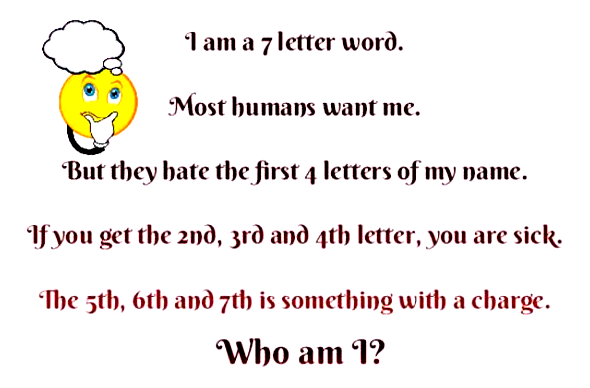
I am a 7 letter word. Most humans want me. But they hate the first 4 letters of my name. If you get the 2nd, 3rd and 4th letter you are sick. The 5th, 6th and 7th is something with a charge. Who am I?
Correct answers: 129
The first user who solved this task is Sanja Šabović.
#brainteasers #riddles

Register with your Google Account and start collecting points.
Check your ranking on list.

After spending a night at a ho...

After spending a night at a hotel with a prostitute, the politician took $300 out of his wallet and placed it on the dressing table.

"Thanks," she said. "But I only charge $20."

"Twenty bucks for the entire night?" the amazed politician replied. "You can't make a living on that."

"Oh, don't worry," the whore replied. "I do a little blackmail on the side!"
Jokes of the day - Daily updated jokes. New jokes every day.
Follow Brain Teasers on social networks

Brain Teasers

puzzles, riddles, mathematical problems, mastermind, cinemania...

Augustus Henry Lane-Fox Pitt-Rivers

Born 14 Apr 1827; died 4 May 1900 at age 73. English archaeologist often called the "father of British archaeology," who stressed the need for total excavation of sites, thorough stratigraphic observation and recording, and prompt and complete publication. Like Sir Flinders Petrie, Pitt-Rivers adopted a sociological approach to the study of excavated objects and emphasized the instructional value of common artifacts. His London home became so crowded with items such as skulls, stone implements, pottery and other works of art that he decided to open a public museum at Bethnal Green, which he arranged according to his evolutionary system. When his collection became too large for Bethnal Green, it was transferred to the University of Oxford, where it is seen today.
This site uses cookies to store information on your computer. Some are essential to help the site properly. Others give us insight into how the site is used and help us to optimize the user experience. See our privacy policy.