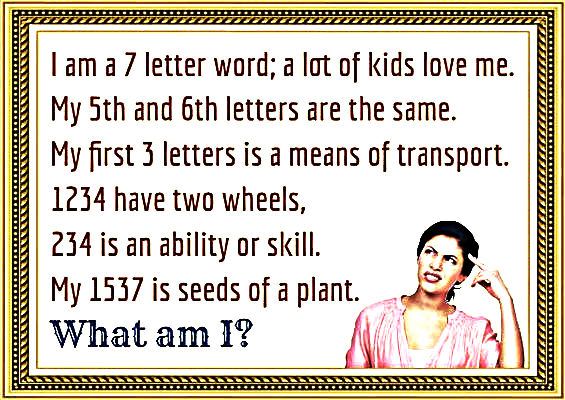
I am a 7 letter word; a lot ...
[3549] I am a 7 letter word; a lot ... - I am a 7 letter word; a lot of kids love me. My 5th and 6th letters are the same. My first 3 letters is a means of transport. 1234 have two wheels, 234 is an ability or skill. My 1537 is seeds of a plant. What am I? - #brainteasers #riddles #sport - Correct Answers: 64 - The first user who solved this task is Linda Tate Young
BRAIN TEASERS
enter your answer and press button OK

I am a 7 letter word; a lot ...

I am a 7 letter word; a lot of kids love me. My 5th and 6th letters are the same. My first 3 letters is a means of transport. 1234 have two wheels, 234 is an ability or skill. My 1537 is seeds of a plant. What am I?
Correct answers: 64
The first user who solved this task is Linda Tate Young.
#brainteasers #riddles #sport
Register with your Google Account and start collecting points.
Check your ranking on list.

Who's Your Daddy?

While the family was sitting around the dinner table, Jennifer, 5, turned to her brother Andy, 3, and pointed to her dad. "That's not your real father," she said, startling the whole family.
"Yes, he is!" Andy replied.
"No, he's not," Jennifer insisted. "God is your heavenly father."
Then pointing at her dad, she said, "That's your homely father!"

Jokes of the day - Daily updated jokes. New jokes every day.
Follow Brain Teasers on social networks

Brain Teasers

puzzles, riddles, mathematical problems, mastermind, cinemania...

Helium liquefied

In 1908, Kamerlingh Onnes made helium liquid at a temperature of 4.2 K (about -269 ºC). He had worked for many years to liquify this element which persisted as a gas to the lowest temperature. Using liquid air to produce liquid hydrogen and then the hydrogen to jacket the liquification apparatus, he produced about 60 cubic centimeters of liquid helium. The gas was liquefied by compressing it, cooling it below the inversion temperature and then allowing it to expand, which causes further cooling resulting in the liquefaction of some of the gas. At his cryogenic laboratory, he had previously liquefied air (1892) in large quantities, and built a large hydrogen liquefier (1906). Onnes received the Nobel Prize in 1913 for his low temperature work.
This site uses cookies to store information on your computer. Some are essential to help the site properly. Others give us insight into how the site is used and help us to optimize the user experience. See our privacy policy.